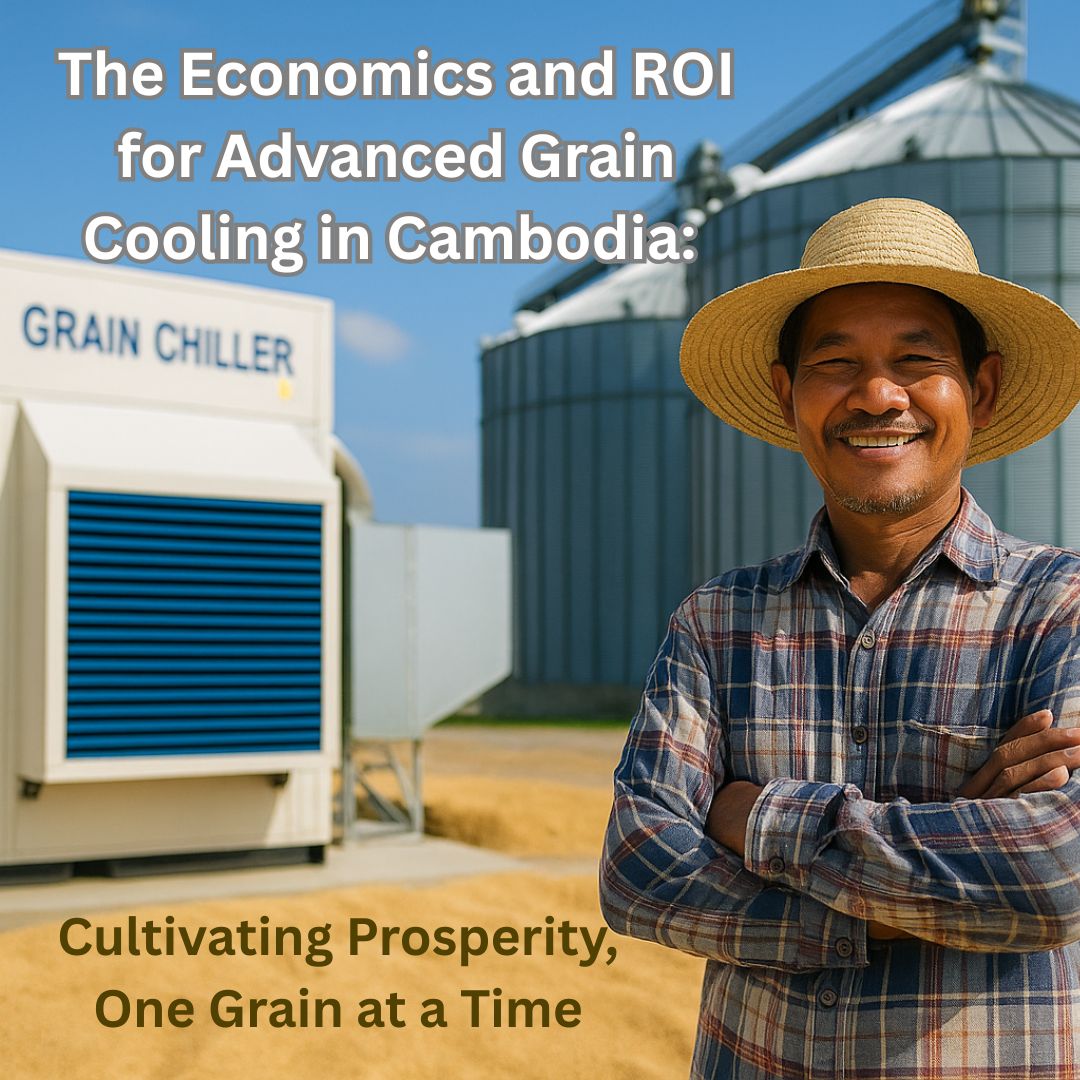
The Economics and ROI for Advanced Grain Cooling in Cambodia: Cultivating Prosperity, One Grain at a Time
The Hidden Cost of Traditional Storage in Cambodia 📉
Despite Cambodia’s status as a major rice producer and exporter, the nation faces substantial post-harvest losses. Estimates often place these losses at up to 18% of the total rice production, a staggering figure that represents millions of dollars in lost income for farmers and a significant drag on agricultural growth. 💰
Traditional storage methods, still prevalent across the country, range from storing paddy in farmers’ homes and simple bamboo or wooden structures to common gunny bags. These methods are highly vulnerable to Cambodia’s challenging climate and pest pressures:
- High Humidity & Temperatures: Cambodia’s tropical climate, characterized by high temperatures and prolonged periods of humidity, creates an ideal breeding ground for mold, fungi, and insect infestations.3 This leads to rapid spoilage and quality degradation.
- Pest Infestation: Insects like the rice weevil and Angoumois grain moth are endemic, causing significant weight loss and physical damage to grains. Farmers often resort to repeated sun-drying or chemical treatments, which can be inefficient, costly, and pose health risks.
- Quality Deterioration: Beyond physical losses, poor storage causes discoloration, breakage during milling, loss of aroma (especially for premium varieties like Phka Rumduol), and reduced germination. This directly impacts the market value of the grain.
- Aflatoxin Risk: High moisture and temperature in inadequate storage facilities can lead to the growth of Aspergillus flavus mold, producing toxic aflatoxins, a major food safety concern and a barrier to export.
These compounded losses undermine farmer livelihoods, reduce export competitiveness, and ultimately hinder Cambodia’s economic development. 🐛🚨
The Investment in Resilience: Modernizing Grain Storage 🏗️
Implementing advanced grain cooling technology requires an upfront capital investment. This includes the chilling unit itself, along with appropriate insulated storage structures (such as modern, smaller-scale silos or improved, airtight warehouses). The cost will vary significantly based on the capacity and sophistication of the system. However, this is not merely an expense; it’s a strategic, long-term asset designed to provide a stable, protected environment for valuable grain for many years.
The Cambodian government, recognizing the importance of improved agricultural infrastructure, has been focusing on food security and enhancing the value chain.4 While direct “grain chilling” subsidies may not be explicitly named, broader initiatives aimed at modernizing agriculture, improving post-harvest technologies, and supporting farmer cooperatives create a conducive environment for such investments. Support from international development partners also plays a crucial role in promoting sustainable agricultural practices and technologies in Cambodia.
The Pillars of ROI: How Advanced Cooling Generates Wealth 📈
The Return on Investment from advanced grain cooling stems from several critical areas, forming a robust financial case for its adoption in Cambodia:
- Dramatic Reduction in Post-Harvest Losses: The Foremost Financial Gain! 🏆
This is the most direct and impactful benefit. By creating and maintaining optimal low temperatures (typically below 15°C, often 10-12°C), advanced cooling effectively:- Eliminates Insect Infestation: Low temperatures halt insect development and activity, making stored grain virtually insect-free without chemical fumigants. This directly saves the significant portion of grain (up to 18%) typically lost to pests. 🐛➡️❌
- Prevents Mold Growth & Aflatoxin Contamination: Chilling maintains low temperatures and controlled humidity, actively inhibiting the growth of molds, especially those that produce dangerous aflatoxins, ensuring safer food and preventing rejection in high-value markets.5 🛡️
- Minimizes Respiration Losses: Grains respire much slower at lower temperatures, preserving their dry matter, weight, and nutritional integrity. As the Grainchat YouTube channel points out, understanding and controlling water loss during storage is key to preventing spoilage and maintaining quality.
- Quantifiable Savings: By reducing physical grain losses from high percentages (e.g., 10-18%) to less than 1-2%, modern chilling preserves thousands to millions of dollars worth of grain annually.
- Superior Grain Quality & Premium Prices 🌟
Advanced cooling does more than prevent loss; it actively preserves and enhances grain quality, translating to higher market value:6- Chemical-Free Preservation: By eliminating the need for chemical fumigants, the grain remains pure and free from residues, increasingly preferred by health-conscious consumers and essential for meeting strict international food safety standards for export. 🚫🧪
- Improved Milling Performance: Preserving kernel integrity and preventing brittleness leads to higher head rice yield, directly increasing the saleable product from the same raw material.
- Enhanced Market Value: High-quality, untainted rice, especially premium varieties like Phka Rumduol, can consistently command higher prices in both local and international markets, offering a substantial direct financial uplift.
- Lower Operational Costs & Increased Efficiency 💰
The long-term operational economics of advanced cooling are highly favorable:- Elimination of Fumigation Costs: Direct savings on pesticides, labor for application, and related safety protocols are immediate and recurring.
- Energy Efficiency: While cooling consumes power, modern grain chillers are designed for efficiency.7 Their operational running cost is often lower than the combined cost of traditional aeration and periodic fumigation, especially when considering the value of avoided losses. 💡
- Reduced Labour & Handling: Automated chilling systems minimize the need for manual intervention and frequent quality checks associated with traditional methods.
- Market Flexibility & Strategic Storage 📊
- Extended Storage Duration: The ability to store grain safely for prolonged periods empowers farmers, traders, and millers to avoid distress sales immediately post-harvest when prices are typically low. They can strategically hold inventory and sell when market prices are optimal, maximizing returns. 🔄
- Reliable Supply Chain: For larger processors and exporters, consistent access to high-quality raw material year-round optimizes production schedules and ensures stable supply, crucial for market reliability.
Case Study: A Cambodian Farmer Cooperative’s Journey to Prosperity 🚀
Let’s consider a hypothetical yet realistic scenario for “Golden Grains Cooperative,” a small rice farmers’ cooperative in Battambang province, Cambodia, comprising 25 families. They collectively harvest approximately 250 metric tons (MT) of premium jasmine rice annually, primarily Phka Rumduol, known for its aroma and export potential.
The Pre-Modernization Challenge:
Golden Grains Cooperative previously stored their paddy in members’ homes and a central village shed using traditional methods like piling bags. They faced significant problems:
- High Post-Harvest Losses: Due to Cambodia’s high humidity and pest issues, the cooperative experienced an average 12-15% loss in quantity from insect damage, mold, and moisture spoilage over their 6-8 month storage period. For 250 MT, this meant 30-37.5 MT of lost rice.
- Quality Degradation & Aflatoxin Risk: Discoloration and aroma loss were common, often leading to their premium rice being downgraded to standard grades. Occasional aflatoxin contamination caused batches to be rejected by export buyers, incurring substantial financial penalties and damaging their reputation.
- Forced Distress Sales: Lacking adequate long-term storage, they were often compelled to sell most of their harvest immediately after the main harvest, when prices were typically 10-15% lower due to abundant supply.
- High Fumigation Costs: Regular attempts to control pests required chemical fumigation, which added costs and labor.
The Chilling Solution:
Golden Grains Cooperative secured a micro-finance loan and community funds to invest in a modern, insulated, modular storage unit with a 200 MT capacity, equipped with an advanced aeration system that can maintain consistent lower temperatures (through ambient air cooling) and humidity, effectively providing a basic form of grain cooling. The initial capital investment for this improved storage system was US$25,000.
Cost vs. Savings & ROI – An Illustrative Look:
Let’s assume the average farm-gate price of premium paddy rice (Phka Rumduol) in Cambodia is US$400 per MT.
- Avoided Quantity Loss: By reducing storage losses from an average of 13% to a negligible 1% with the improved storage, Golden Grains Cooperative saves 12% of 200 MT, which is 24 MT of paddy.
- Monetary Savings from Loss Reduction: 24 MT * US$400/MT = US$9,600 annually.
- Value from Quality Preservation (Premium Price & Aflatoxin Avoidance): By consistently preserving the aroma and quality of their premium rice and avoiding aflatoxin contamination, the cooperative can command a 7% quality premium on their rice for export-grade buyers.
- Monetary Gain from Quality Premium: (200 MT * US$400/MT) * 7% = US$5,600 annually.
- Market Flexibility (Avoiding Distress Sales): The ability to store safely for several months allows them to sell their rice later in the season when prices are typically 15% higher.
- Monetary Gain from Delayed Sale: (200 MT * US$400/MT) * 15% = US$12,000 annually.
- Operational Cost of Storage (Aeration & Maintenance): The electricity for the aeration system and basic maintenance would be relatively low, estimated at US$500 annually. They also save on chemical fumigation costs.
The Compelling ROI for Golden Grains Cooperative:
- Total Annual Savings/Gains: US$9,600 (Loss Reduction) + US$5,600 (Quality Premium) + US$12,000 (Market Flexibility) = US$27,200 annually.
- Net Annual Benefit (after estimated operational cost): US$27,200 – US$500 = US$26,700 annually.
With an initial investment of US$25,000 and an annual net benefit of US$26,700, Golden Grains Cooperative’s investment in the modern, cooling-enabled storage unit had an incredibly rapid payback period of less than 1 year (approx. 0.94 years). After this, the benefits are sustained annual gains that significantly boost the cooperative’s profitability and its members’ incomes.
The Outcome:
Golden Grains Cooperative not only secured their harvest from significant losses and quality degradation but also gained remarkable market power. They could consistently supply safer, higher-quality premium rice, ensuring better returns for their member farmers and establishing a reputation as a reliable supplier. This hypothetical example vividly illustrates how advanced grain cooling, even at a small cooperative level, directly translates into tangible financial gains and improved livelihoods for agricultural communities in Cambodia.
Government and Development Partner Support: Catalyzing Investment 🤝
The Cambodian government, alongside numerous international development partners (like USAID, FAO, JICA, GIZ), is actively working to improve post-harvest management and enhance food security.8 While specific “grain chilling” subsidies are emerging, broader support frameworks exist that facilitate such investments:
- Agricultural Development Policies: Focus on modernizing agriculture, improving productivity, and reducing post-harvest losses are central to national strategies.9
- Credit and Financial Access: Programs and initiatives by the Rural Development Bank and micro-finance institutions (MFIs) provide access to loans for farmers and cooperatives to invest in agricultural infrastructure, including improved storage.
- Capacity Building & Training: Development partners often provide technical assistance and training to farmers and cooperatives on best post-harvest practices and the adoption of modern technologies.
- Value Chain Development: Projects aimed at strengthening rice value chains inherently support investments that enhance quality and reduce losses, such as advanced storage solutions.
These concerted efforts from the Cambodian government and its partners significantly de-risk and accelerate the ROI for modern storage technologies, making them more accessible and viable for a wider range of stakeholders, from smallholder farmers to larger rice mills.
The Bottom Line: A Resilient, Profitable Future 🎯
The economics unequivocally support the adoption of advanced grain cooling in Cambodia. The substantial financial savings from dramatically reduced losses (addressing that up to 18% post-harvest loss), the premium gained from superior grain quality and safety, and lower long-term operational costs, collectively generate a compelling ROI. When coupled with government and development partner support, the investment in modern grain chilling becomes not just viable, but a strategic imperative for profitability and long-term sustainability for Cambodia’s vital agricultural sector.
Take the Next Step
If you’re ready to advance your career in food and agribusiness:
Explore Avila University’s Agribusiness Certificate Programs
Identify the certificate that aligns with your career stage
Connect with admissions advisors to plan your learning pathway
Learn more:
https://www.avila.edu/avila-agribusiness-programs/