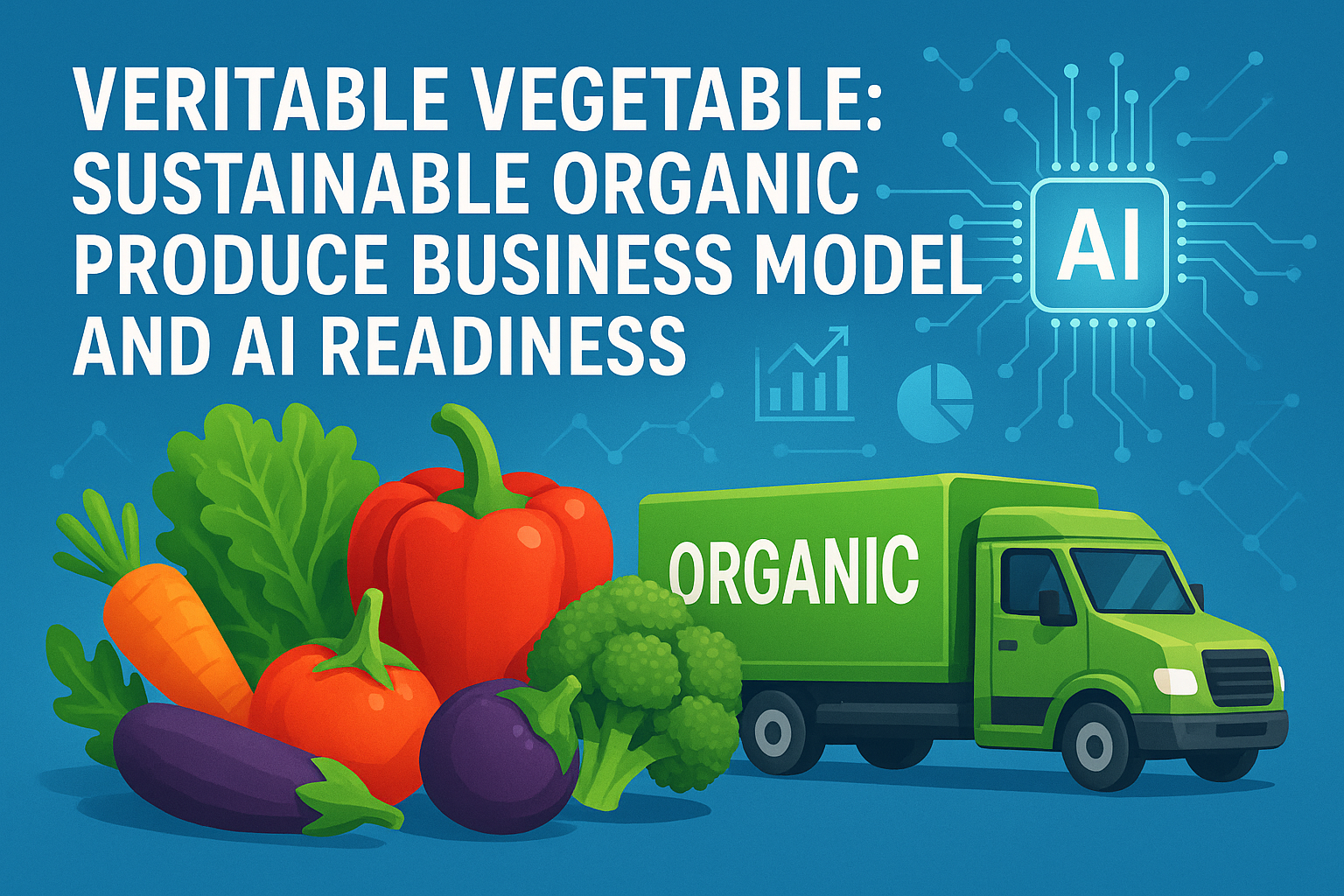
Business Model Innovation and AI Readiness in Sustainable Produce Distribution: The Veritable Vegetable Example
Introduction: The Journey of Veritable Vegetable
In 1974, in San Francisco’s vibrant food co-op movement, a pioneering group of women launched Veritable Vegetable—fueled by a vision for equitable, direct-from-farm organic distribution12. Facing fragmented channels and absence of trusted organic supply at scale, they forged a mission: support small-to-mid-size organic growers, ensure fair pricing, and deliver unmatched produce quality to a growing base of retailers, restaurants, and institutional buyers34.

Their commitment shaped a radically different enterprise—female-owned, value-led, and steeped in community relationships. Over decades, sustainability, labor equity, and “green fleet” logistics reinforced their difference. Fast-forward to today: Veritable Vegetable remains an anchor of the Western US organic sector, distributing to six states, reinvesting a share of profits in community organizations, and seeking to be a model for business that serves people, planet, and profit142.
As consumer awareness of environmental impact and supply chain transparency surges, the fresh vegetable market is forecasted for robust growth—creating space for businesses that authentically embody purpose and measurable sustainability action56.
The IFAL Business Model Framework: Four Critical Elements
The IFAL Business Model Framework centers on four key pillars to analyze and design resilient, sustainable, and profitable agrifood ventures:
Value Proposition: Identifies the core customer/consumer segment and the attributes they are willing to pay for.
Distribution Strategy: Outlines the revenue model tied to the channels that deliver products/services to these target segments.
Complementary Partnerships: Details the essential external alliances and interdependencies needed to create and scale value.
Sustainability Components: Assesses the economic, social, and environmental outcomes the business delivers for stakeholders.
This framework is core to IFAL’s Mini MBA curriculum, where real-world cases and interactive exercises prepare learners to apply, test, and innovate business models in global food systems.
🎯 Target Segment & Value Proposition (Applying IFAL Framework)
Target Segment Analysis
Veritable Vegetable’s primary customers include:
Retailers (independent grocers, co-ops, specialty stores)
Foodservice operators (restaurants, schools, hospitals, corporate cafeterias)
Regional focus: Western US, covering California, Nevada, Arizona, New Mexico, Colorado, Hawaii
These buyers prioritize—often at a premium:
Consistent, certified-organic supply
Fair grower pricing and food provenance
Low-carbon, reliable distribution
Value Proposition and Competitive Differentiation
Direct-from-farm sourcing for freshness and traceability
Small/mid-sized grower partnership—meaningful impact in rural economies
Award-winning green fleet and 99% waste diversion
Continuous reinvestment in social impact, living wages, and environmental upgrades15

While large-scale produce giants might compete on sheer volume, Veritable Vegetable stands apart by fusing market reputation with authentic sustainability outcomes and lasting farmer/retailer loyalty274.
Reasoning: Most modern food buyers, according to sector trends, are focused on trustworthy, transparent supply and demonstrable sustainability, making Veritable Vegetable’s approach a visible benchmark and a strong business case for those interested in values-driven growth58.
🛒 Distribution Strategy (Using IFAL Business Model Framework)
Distribution Model
Fleet operations: Zero-emissions vehicles, optimized for efficiency and produce quality.
Channel mix: Deliveries via established grocery/foodservice relationships; less reliance on online channels due to perishable product constraints.
Geographic reach: Focused, adaptive logistics in Western US with customer-centric routing and service46.

Areas for Improvement:
Digital engagement: Public data indicates modest adoption of digital sales and customer-facing inventory tools—a known challenge/opportunity in perishables.
Potential: Leading best practices, such as customer ordering portals and real-time inventory, can strengthen responsiveness and empower B2B buyers910.
Reasoning: In the food sector, channel choice reflects both consumer behavior and product attributes. Most sales of perishable produce remain offline, but digital transformation (AI for routing, demand prediction) can further sustainability and efficiency, as public scenarios demonstrate1112.
🤝 Complementary Partnerships (According to IFAL Principles)
Strategic Value and Partnership Models
Farmers: Over 100+ small/mid-scale organic suppliers—some relying almost exclusively on Veritable Vegetable for market access.
Community organizations: Regular contributions (over 10% of profits) to schools, anti-hunger initiatives, and educational outreach.
Policy and advocacy networks: Engaged in food policy, certified B Corp, leadership roles in sustainable agriculture circles.
Certifiers: Organic and green business certifications build external trust13.
Benefits:
Risk reduction through diversified supply
Improved social and reputational capital
Shared innovation via ongoing policy and sustainability collaborations
Reasoning: Industry consensus affirms: robust, trust-based alliances underpin enduring, profitable food supply chains and create sector resilience513.
🌎 Sustainability as the Core Value
Veritable Vegetable’s model prioritizes:
Environmental impact: 99% waste diversion, renewable power, and green fleet initiatives drive measurable emissions reduction15.
Social outcomes: Above-living-wage pay, participatory management, and major investments in local communities.
Economic value: Supports rural livelihoods and circular regional economies through fair pricing and stable purchasing relationships1362.

Reasoning: Public case data and sector benchmarks confirm that integrated sustainability (not add-on measures) now shapes procurement, investor, and policy decisions—and is a driver of superior long-term business performance.
AI Readiness Assessment: Our Analysis for Business Readiness
Public indicators suggest that AI adoption in organic distribution is nascent but growing, shaped by barriers like supply chain complexity, perishability, and historic reliance on human relationships1314. However, as per global trends, companies with a values-driven digital presence and demonstrated openness to sustainability technology are poised for selective AI integration1210.
Assessment:
Digital foundation: Veritable Vegetable’s website, active social media, and public sustainability reporting showcase foundational readiness4.
Opportunities:
AI-powered route optimization
Predictive analytics for demand management and waste reduction
Automated, targeted content marketing and lead engagement tools
Suggestion: Start with content and sales workflow automation (reducing team burden), followed by phased integration of AI tools for logistics, customer service automation, and data-driven decision-making—aligned with global sector best practices1112.
To learn how to operationalize these AI strategies, explore the IFAL Mini MBA in Sustainable Food Supply Chains—where practical business modeling skills meet technology for actionable impact.
Leveraging AI for Process Efficiency, Value Creation, and Delivery
Recent research highlights AI’s value from farm to plate by enhancing precision, minimizing losses, and strengthening system transparency1413. Even modest adoption—starting with workflow automation in sales or logistics—frees up teams for strategic work, increases buyer trust, and accelerates market responsiveness61210.
Application Scenarios:
Predictive analytics: Use AI algorithms to forecast produce demand based on external data (e.g., weather, past sales), reducing overproduction and minimizing spoilage.
AI-powered logistics: Route optimization engines can lower emissions and costs by planning the most efficient delivery sequences for perishable goods.
Automated lead engagement: Chatbots or AI-driven CRM tools handle initial inquiries, nurture leads, and deliver tailored marketing, all while creating analytics to improve customer experience111210.
Quality assurance: Computer vision inspects for defects and enhances both food safety and consistent quality, drawing on global best-practice models1415.
Public Example:
Many leading distributors use AI in logistics to reduce emissions and improve cold chain management—boosting both environmental and economic outcomes61112.
FAQs
Q: What makes Veritable Vegetable’s model unique in the organic food sector?
A: Their focus on women-owned leadership, partnership with small growers, advanced green logistics, and significant reinvestment in social/environmental action distinguish them from mainstream distributors126.
Q: How can AI help reduce waste in organic supply chains?
A: AI improves demand forecasting, route optimization, and real-time inventory management, all of which reduce spoilage, emissions, and costs141110.
References
Veritable Vegetable – Certified B Corporation
Who We Are – Veritable Vegetable
Veritable Vegetable: Organic Produce Wholesale Distributor
Veritable Vegetable demonstrates sustainability through action
Veritable Vegetable | San Francisco Legacy Business
The Role of AI in Sustainable Food Supply Chains
[PDF] Mini MBA in Sustainable Food Supply Chains – IFAL
Veritable Vegetable Information – RocketReach
AI-driven transformation in food manufacturing: a pathway
Mini MBA in Sustainable Food Supply Chains, YouTube (IFAL)
Green Fleet of the Year: Veritable Vegetable | FleetOwner
The Role of AI in Transforming Supply Chains in the Food Agriculture Sector
Veritable Vegetable Inc – Idealist
Unlocking AI’s potential in the food supply chain: a novel perspective
Veritable Vegetable – Free Range
Artificial Intelligence in Sustainable Food Design
Sustainable Food Supply Chains through Artificial Intelligence
Disclaimer (Educational Purposes Only)
This post is for educational and illustrative purposes as part of the Agribusiness Academy Blog and is intended to guide learning and discussion. The analysis may not fully represent the proprietary business practices of Veritable Vegetable, and all facts are based solely on external/public sources. We invite corrections or debate on any points presented.
Take the Next Step
If you’re ready to advance your career in food and agribusiness:
Explore Avila University’s Agribusiness Certificate Programs
Identify the certificate that aligns with your career stage
Connect with admissions advisors to plan your learning pathway
Learn more:
https://www.avila.edu/avila-agribusiness-programs/
References
- https://www.bcorporation.net/en-us/find-a-b-corp/company/veritable-vegetable/
- http://www.legacybusiness.org/business/veritable-vegetable
- https://rocketreach.co/veritable-vegetable-profile_b5f6cd58f42e8ef8
- https://veritablevegetable.com
- https://www.foodlogistics.com/sustainability/article/21070366/veritable-vegetable-demonstrates-sustainability-through-action
- https://www.fleetowner.com/emissions-efficiency/article/21682509/green-fleet-of-the-year-veritable-vegetable
- https://freerange.com/case-studies/veritable-vegetable
- https://www.ifal.ac/mini-mba-sustainable-supply-chains
- https://learning.agribusiness.academy/mini-mba-sustainable-food-supply-chains/
- https://industry-science.com/en/articles/sustainable-food-supply-chains-through-artificial-intelligence/
- https://investpunjabblog.com/2025/04/01/the-role-of-ai-in-transforming-supply-chains-in-the-food-agriculture-sector/
- https://www.sciencedirect.com/science/article/pii/S2666154324003867
- https://prism.sustainability-directory.com/scenario/the-role-of-ai-in-sustainable-food-supply-chains/
- https://pmc.ncbi.nlm.nih.gov/articles/PMC11966451/
- https://www.sciencedirect.com/science/article/abs/pii/S0924224425002882
- https://www.youtube.com/watch?v=hjNK_ZR1lT8
- https://learning.agribusiness.academy/product/mini-mba-in-sustainable-food-supply-chains-250-hours-of-total-effort/
- https://veritablevegetable.com/whoweare/
- https://www.idealist.org/en/business/ba67470271844ee28ae95c6a8a6cf7b5-veritable-vegetable-inc-san-francisco