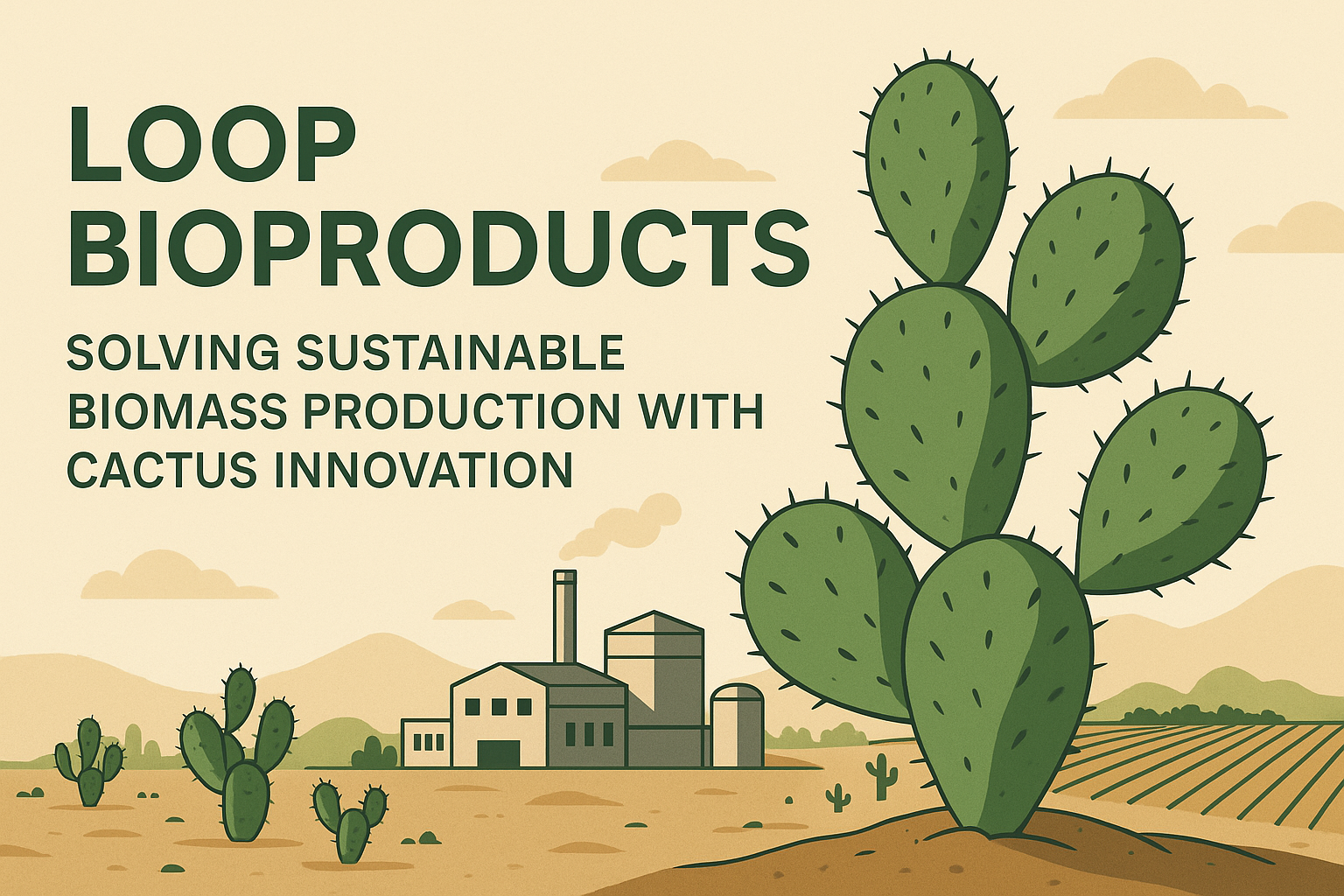
🌵 Loop Bioproducts Business Model: Solving Sustainable Biomass Production with Cactus Innovation
Introduction: From Neuroscience to Bio-Circular Economy — The Loop Bioproducts Story

Rhiannon Parker’s journey from neuroscience and petroleum to eco-innovation is a tale of transformation that reads like a modern parable for sustainable business. Bootstrapping her vision rather than chasing venture capital, Rhiannon founded Loop Bioproducts to address two mounting challenges: the world’s insatiable resource consumption and the urgent need to regenerate worn-out land and ecosystems, especially in drought-prone regions.

Traditionally, land reclamation and biomass production have struggled with inputs, climate constraints, or unsustainable practices. Parker bet on the opuntia cactus—better known as prickly pear—a plant capable of thriving in the harshest, driest soils while delivering rapid renewable biomass. By partnering with indigenous communities, adopting regenerative agriculture, and integrating the latest agronomic research, Loop Bioproducts is not just producing eco-friendly materials—they are rewriting how the agriculture and materials industries think about land, water, and circularity.
The company’s innovation is timely. The global market for alternative biomaterials, biogas, and sustainable packaging is expected to soar in the coming decade, with increasing demand from industries seeking lower-cost, lower-carbon substitutes for plastics, paper pulp, and traditional animal- or fossil-derived ingredients. Opuntia’s sustainability edge—resilient photosynthesis, efficient water use, rapid regrowth, and carbon sequestration—unlocks the potential for scalable, climate-smart products.
Loop’s ecosystem connects agricultural producers, research institutions, corporates, and environmental stewards, creating a virtuous cycle that brings resilient, affordable, and sustainable products to markets often ignored by mainstream biomanufacturing.
The IFAL Business Model Framework
Loop Bioproducts’ business model strength is assessed through four critical elements:
Value Proposition: The core customer segment and unique product/service attributes valuable to those customers.
Distribution Strategy: How the company delivers its value—including both the go-to-market channels and revenue logic.
Complementary Partnerships: The role of external collaborators (R&D, supply chain, technology, advisory) in enabling scale and profitable economics.
Sustainability Elements: The economic, social, and environmental outcomes delivered by the company’s innovation.
🎯 Target Segment & Value Proposition
Loop Bioproducts focuses on B2B customers—biomaterials and bioenergy producers, green chemical firms, food tech innovators, and climate-focused corporates. Their offer appeals to organizations seeking sustainable, affordable, and high-performing feedstocks that do not compete with food crops or exacerbate land degradation.
Differentiator: Cactus (specifically spineless opuntia) is a drought-tolerant, rapidly regenerating plant capable of thriving on marginal land. This enables:
Continuous renewable biomass production, even in arid and degraded environments.
A diverse array of outputs: fermentation substrates, biogas, biofertilizer, vegan leather, biodegradable films, and materials for packaging and textiles.
Lower input costs and greater climate resilience, supporting the circular bioeconomy at a market-relevant scale.
Loop’s approach allows partners and customers to transition away from fossil-based materials and traditional biomass sources, unlocking new value in sectors pressed by sustainability mandates and supply chain risk.
🛒 Distribution Strategy
Loop Bioproducts’ go-to-market strategy blends direct partnerships with agricultural producers, B2B sales to green chemistry and biomanufacturing firms, and alliances with corporates eager to decarbonize their supply chains.
Currently, distribution favors high-impact, reciprocal partnerships—direct supplier agreements with manufacturers and collaborative pilots with R&D organizations. As the market matures, Loop can expand into licensing models, white-label solutions, and broader integration into bio-based value chains.
Future distribution opportunities include digital commerce for specialist ingredients, co-development with packaging/food producers, and tie-ins with ESG-driven impact investment channels.
🤝 Complementary Partnerships
Loop’s business is built on deep, reciprocal relationships across the agricultural and research ecosystem:
Agricultural Producers: Enable scalable cactus cultivation adapted to local climates, improving farmer resilience.
Research Institutes: Bring agronomic, biotechnological, and environmental expertise, catalyzing new product development.
Corporates: Provide capital, market access, and application R&D for new biomaterials.
Environmental Stewards: Ensure best practices in regenerative land management and community inclusion.
These partnerships accelerate innovation, de-risk scale-up, and cement Loop’s role as both supplier and collaborator in the bioeconomy.
🌎 Sustainability at the Core of the Business Model
Sustainability is not a side effect for Loop—it’s the beating heart of the proposition:
Environmental: Cactus-driven biomass uses scant water, captures carbon, rehabilitates degraded land, and produces low-impact, biodegradable output streams.
Social: Direct engagement with local producers empowers rural economies and promotes indigenous stewardship.
Economic: Circular use of byproducts (e.g., digestate as biofertilizer or paper pulp) means nothing goes to waste, and profitability is enhanced by lower commodity risk and regulatory favorability.
AI Readiness Assessment for Company
Like many specialist agbiotech firms, Loop Bioproducts exhibits a promising—if nascent—AI readiness across digital channels:
Strengths: The company’s focus on ecosystem partnerships and research-driven collaboration hints at openness to data-driven innovation. The narrative-driven website and the positioning on regenerative agriculture show a strategic understanding of the themes that drive inbound interest and engagement.
Opportunities: Public digital presence (website, thought leadership) lays groundwork for AI-driven business development, including advanced content marketing, precision lead generation, and automation of knowledge sharing.
Gaps: Scaling content and making their technical expertise discoverable in B2B digital channels will be essential to capture more leads and drive market growth with a lean team.
Compared to global sector trends, firms leveraging AI for business development (content automation, predictive lead scoring, B2B sales enablement) consistently see faster market penetration, better-qualified leads, and improved capital efficiency. Loop could benefit from AI-driven automation to support internationalization, scalable pipeline building, and targeted partner outreach.
Leveraging AI for Process Efficiency, Value Creation, and Delivery
Loop Bioproducts can harness AI in several ways aligned to best-practice public scenarios:
Content Automation: AI-powered content generation tools can deliver regular thought leadership, case studies, and partnership updates—improving visibility and authority while maintaining a lean team.
Lead Generation and Qualification: Predictive AI models can prioritize high-fit leads from inbound traffic, LinkedIn, or specialized B2B forums—reducing manual workload and uncovering new opportunities globally.
Data Integration and Knowledge Management: Advanced data curation solutions can surface insights from agronomic R&D, customer feedback, and market trends, enabling rapid iteration of value propositions or new product pilots.
Operational Efficiency: AI-driven forecasting can optimize production planning, supply chain logistics, and farm-level crop management—maximizing yield, minimizing waste, and aligning output to market demand.
Example: By deploying a Content Marketing AI agent, Loop could double its digital engagement and inbound leads without increasing its comms or sales headcount—a proven strategy across agrifoodtech startups and scaleups.
Relevance of AI Agents for Business Development
Content Lead Agent
Automates production of technical marketing content, research summaries, newsletters, and educational campaigns. Empowers Loop to consistently communicate its value proposition to global partners, enhance SEO, and keep stakeholders engaged—without manual effort.
Content Marketing Agent
Coordinates, schedules, and refines campaigns across web, social, and B2B platforms—amplifying reach, tailoring messages to segments, and nurturing the brand’s leading-edge image. Loops can access global markets and investor pools 24/7 with minimal in-house capacity.
Lead Generation Agent & Request for Proposal Agent
Lead Generation: Identifies qualified B2B buyers, research collaborations, or supply chain partners using AI-driven targeting and outreach. Reduces cost of business development, shortens sales cycles, and allows Loop to scale presence in new geographies or verticals quickly.
RFPA: Automates scanning and response for grant opportunities, RFPs, and innovation challenges, ensuring Loop is consistently visible in high-value, non-dilutive funding or partnership scenarios.
These agents collectively enable rapid, efficient scaling of Loop’s business reach, partner pipeline, and revenue generation, all while keeping stress and human resource requirements at a minimum—hallmark benefits noted in advanced business development models.
Key Takeaways
Loop Bioproducts revolutionizes sustainable biomass by harnessing drought-tolerant cactus as a regenerative, circular input for bioproducts.
The business model thrives on ecosystem partnerships, circular economic value streams, and robust environmental and social impact.
AI adoption in content marketing, lead generation, and opportunity automation can dramatically scale market impact and operational efficiency.
B2B AI agent solutions enable Loop to expand, innovate, and lead in sustainable agribusiness, even with a small team.
Conscious integration of sustainability, partnership, and digital best practices positions Loop for category leadership in the growing circular bioeconomy.
Take the Next Step
If you’re ready to advance your career in food and agribusiness:
Explore Avila University’s Agribusiness Certificate Programs
Identify the certificate that aligns with your career stage
Connect with admissions advisors to plan your learning pathway
Learn more:
https://www.avila.edu/avila-agribusiness-programs/