Vital Farms Business Model: How Ethical Eggs & Butter Drive Premium Growth
Introduction
In 2007, Matthew O’Hayer launched Vital Farms in Austin, Texas, starting with just 20 hens driven by one mission: bring ethically produced food to every family’s table. He recognized a growing consumer demand for transparency, animal welfare, and flavor beyond conventional options. As shoppers became aware of factory farming inefficiencies, Vital Farms positioned itself squarely in that void—providing pasture‑raised eggs and later, grass‑fed butter, with full farm-traceability .
From supporting small family farms and prioritizing hen welfare to pioneering regenerative practices, Vital Farms tapped into a powerful convergence of ethical values and market opportunity. Today, with over 425 partner farms and distribution in 24,000 U.S. stores, Vital Farms is on track to reach $1 billion in revenue by 2027. This meteoric rise highlights unmet consumer needs: humane farming, sustainable production, and traceable, high-quality goods.
🧭 Applying IFAL’s Business Model Framework
The Institute for Food & Agribusiness Leadership (IFAL) helps us dissect Vital Farms’ model through five lenses: target segment & value proposition, distribution, partnerships, revenue streams, and sustainability. This structured view reveals how integrated ethical practices align with profitable growth and systemic impact.
🎯 Target Segment & Value Proposition
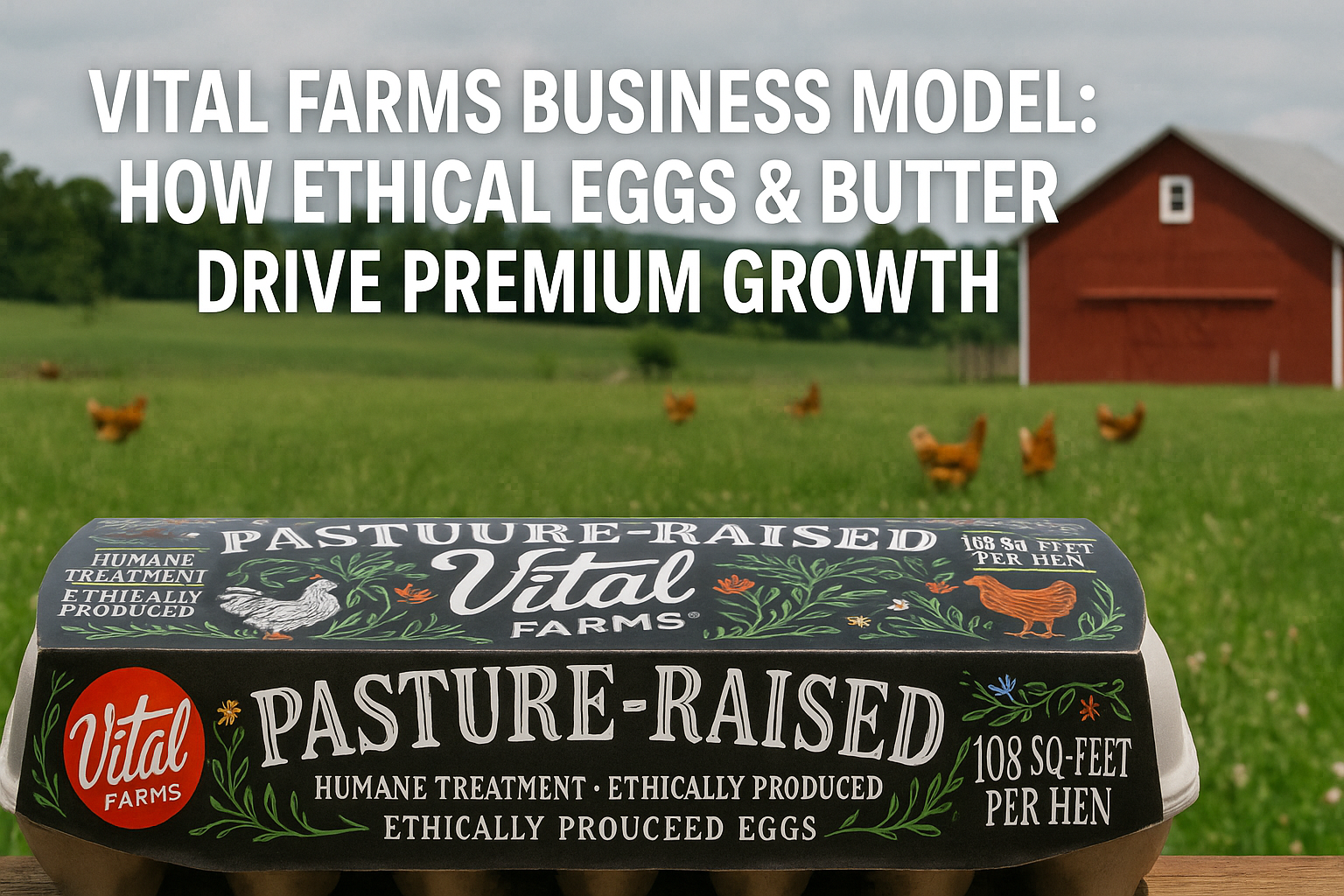
Vital Farms targets health-conscious, ethically minded consumers and premium foodservice providers. These buyers are willing to pay 2–3× standard egg prices for assurance that hens roam freely (108 sq ft each), meat is humane, and farms are verifiable. Key value drivers:
Animal welfare: Transparent, pasture-raised standards with USDA organic options like Restorative Eggs
Traceability: “Trace your farm” feature gives each carton QR-enabled access to a 360° tour of the actual farm
Consumer trust: Certified B‑Corp, public benefit corporation status, and visible marketing reinforce authenticity.
🛒 Distribution Strategy
Vital Farms employs a multi-channel distribution model:
Retail: Partnerships with major grocers like Whole Foods, Kroger, and others—products available in ≈24K stores.
Foodservice: Supplying cafes, restaurants, & institutions with liquid eggs and hard-boiled options .
Digital & D2C: Online traceability tools support product sales through e-commerce.
Media blitz: Campaigns like “Good Eggs. No Shortcuts.” run across streaming platforms (Netflix, Hulu) and social channels to boost brand visibility.
Future growth is tied to enhancing packing capacity (e.g., Seymour, Indiana facility) and expanding production via new family farms.
🤝 Complementary Partnerships
Vital Farms builds a network of 425+ independent family farms, equipped with farmer-support teams to ensure high welfare and organic certifications
Packaging partners: Collaborates with Hartmann for eco-friendly carton design
Logistics partners: Third-party processors (e.g., Egg Central Station in Missouri) enable scalable operations.
Marketing & certification: Works with ad agencies (e.g., GUT Miami) for advocacy campaigns and secures B-Corp and PBC certifications.
These alliances empower quality standards, brand storytelling, and ethical scale.
🌎 Sustainability at the Core
Operating as a Public Benefit Corporation and B-Corp, Vital Farms measures success by impacts on farmers, animals, environment, communities, employees, and shareholders.
USDA Certified Organic and regenerative “Restorative Eggs” support soil health, biodiversity, and carbon sequestration.
Distributed small-scale farms reduce infection risk (e.g., bird flu), demonstrated by limited outbreaks and stable supply.
📝 Key Takeaways
A purpose-led differentiator: Vital Farms leverages transparency and fair farmer relationships to command premium pricing and trust.
Integrated operations: Scaling ethical farming via farmer networks, packaging infrastructure, and marketing creates a defensible model.
Sustainability-anchored expansion: From regenerative eggs to facility upgrades, growth aligns with ethics and resilience.
Healthy financial tailwinds: Strong margins, rising revenues, and antibiotic-free product lines give investors confidence—even amid egg market volatility.
📚 Next Steps for Agribusiness Leaders
Vital Farms exemplifies how conscious capitalism can scale in food systems. Whether refining regenerative supply chains, building traceable brands, or deploying supply resilience strategies, their playbook is instructive.
Take the Next Step
If you’re ready to advance your career in food and agribusiness:
Explore Avila University’s Agribusiness Certificate Programs
Identify the certificate that aligns with your career stage
Connect with admissions advisors to plan your learning pathway
Learn more:
https://www.avila.edu/avila-agribusiness-programs/
📚 References
Vital Farms Official Website – https://www.vitalfarms.com/
Vital Farms Investor Relations – https://investors.vitalfarms.com/
B Corporation Profile – https://www.bcorporation.net/en-us/find-a-b-corp/company/vital-farms-inc
SEC Filings (10-K, 10-Q reports) – https://www.sec.gov/edgar/browse/?CIK=0001579733
USDA Organic Certifications – https://www.ams.usda.gov/services/organic-certification
Good Eggs. No Shortcuts. Campaign – https://adage.com/article/marketing-news-strategy/vital-farms-ad-campaign-2023/2468526
Hartmann Packaging – https://www.hartmann-packaging.com/
Traceability Feature – https://traceability.vitalfarms.com/
Restorative Eggs – https://www.vitalfarms.com/restorative-eggs/
Vital Farms GUT Miami Ad Campaign – https://www.gut.agency/work/vital-farms
Yahoo Finance – https://finance.yahoo.com/quote/VITL/
Supermarket News: Vital Farms growth – https://www.supermarketnews.com/
Whole Foods Supplier Page – https://www.wholefoodsmarket.com/