If you have ever looked at the food on a supermarket shelf and thought, “There is a lot more behind this than farming,” you are already thinking about agribusiness management.
A tomato does not become a tomato sauce jar because a farmer grew tomatoes. It becomes a finished product because seeds were developed, inputs were financed, crops were managed, harvests were sorted, products were processed, labels were designed, logistics were coordinated, retailers placed orders, and someone made sure the numbers worked at every step.
That bigger system is agribusiness. And the people who help it work commercially, strategically, and sustainably are working in agribusiness management.
This matters more than ever. Food systems are becoming more digital, more global, more sustainability-focused, and more complex. Employers increasingly need professionals who understand not just production, but also value chains, business models, distribution, finance, technology, and market demand.
This guide explains what agribusiness management is, how it differs from agriculture, what agribusiness managers do, what careers exist in the field, and why learning to think in value chains is becoming a major advantage.
What You’ll Learn in This Article
- What is agribusiness management?
- Agribusiness management definition in plain English
- What is the difference between agribusiness and agriculture?
- What does agribusiness management include?
- What do agribusiness managers actually do?
- Why does agribusiness management matter?
- What skills are needed in agribusiness management?
- What careers can you pursue in agribusiness management?
- Why value chains matter in agribusiness management
- How do you start learning agribusiness management?
- Frequently asked questions
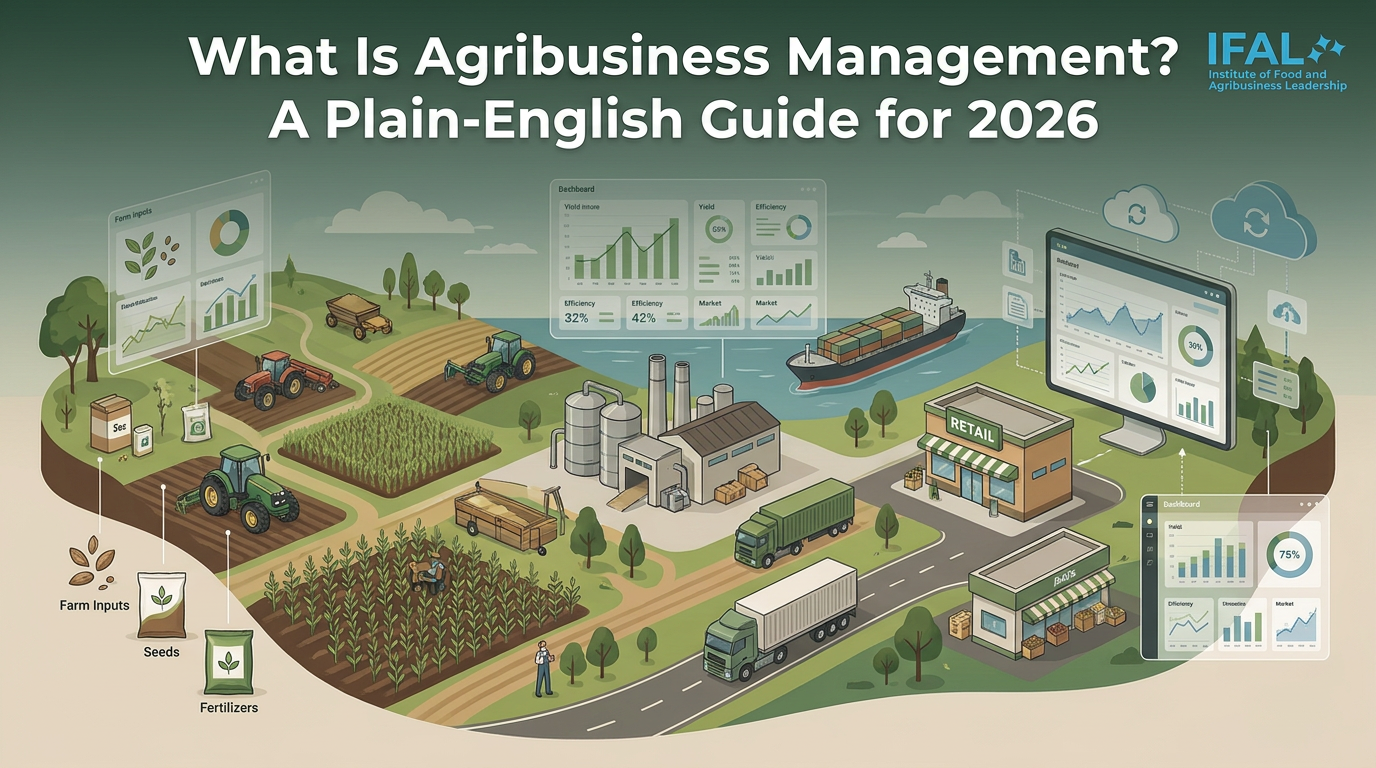
Agribusiness management connects farm production with processing, logistics, markets, and consumers across the full agrifood system.
What is agribusiness management?
Agribusiness management is the business management of the food and agriculture system. It involves planning, organizing, financing, operating, marketing, and improving the activities that move products from farm inputs to farms, processors, distributors, retailers, and finally to consumers.
In simple words, agribusiness management is about how food and agriculture work as a business.
It includes decisions such as:
- what inputs to buy
- how to improve farm productivity
- how to process food profitably
- how to package and transport products
- how to reach the right markets
- how to manage costs, risk, and cash flow
- how to build a stronger business model across the value chain
Agribusiness management is the practice of managing the businesses, decisions, and relationships that bring agricultural products from input suppliers and farms to processors, markets, retailers, and consumers.
That is why agribusiness management is broader than many people first assume. It is not only about running a farm. It is about understanding the entire commercial ecosystem around food and agriculture.
Agribusiness management definition in plain English
A more formal agribusiness management definition would describe it as the application of management principles to businesses involved in agricultural production, processing, distribution, marketing, finance, and related services.
But plain English is better here.
Think of it this way:
- Agriculture grows crops and raises livestock
- Agribusiness turns that production into a functioning market system
- Agribusiness management makes that system work better
It helps answer questions like:
- Where is value created?
- Where is value lost?
- Which technology improves efficiency?
- Which market channel is most profitable?
- Which partnerships strengthen the business?
- How can the business grow sustainably?
That is why agribusiness management sits at the intersection of business, food systems, supply chains, strategy, finance, operations, technology, and sustainability.
What is the difference between agribusiness and agriculture?
This is one of the most important distinctions to understand.
Agriculture
Agriculture mainly refers to primary production:
- growing crops
- raising livestock
- managing soil, water, and inputs
- harvesting farm output
Agribusiness
Agribusiness is much broader. It includes the full network of businesses that support, move, transform, finance, and sell agricultural products.
- seed and input suppliers
- farm operations
- storage and aggregation
- processors and manufacturers
- packaging and labeling businesses
- transport and logistics providers
- wholesalers and distributors
- retailers and food service companies
- agri-finance providers
- agritech firms
- export and trade businesses
Agriculture is production. Agribusiness is production plus everything that connects production to the market.
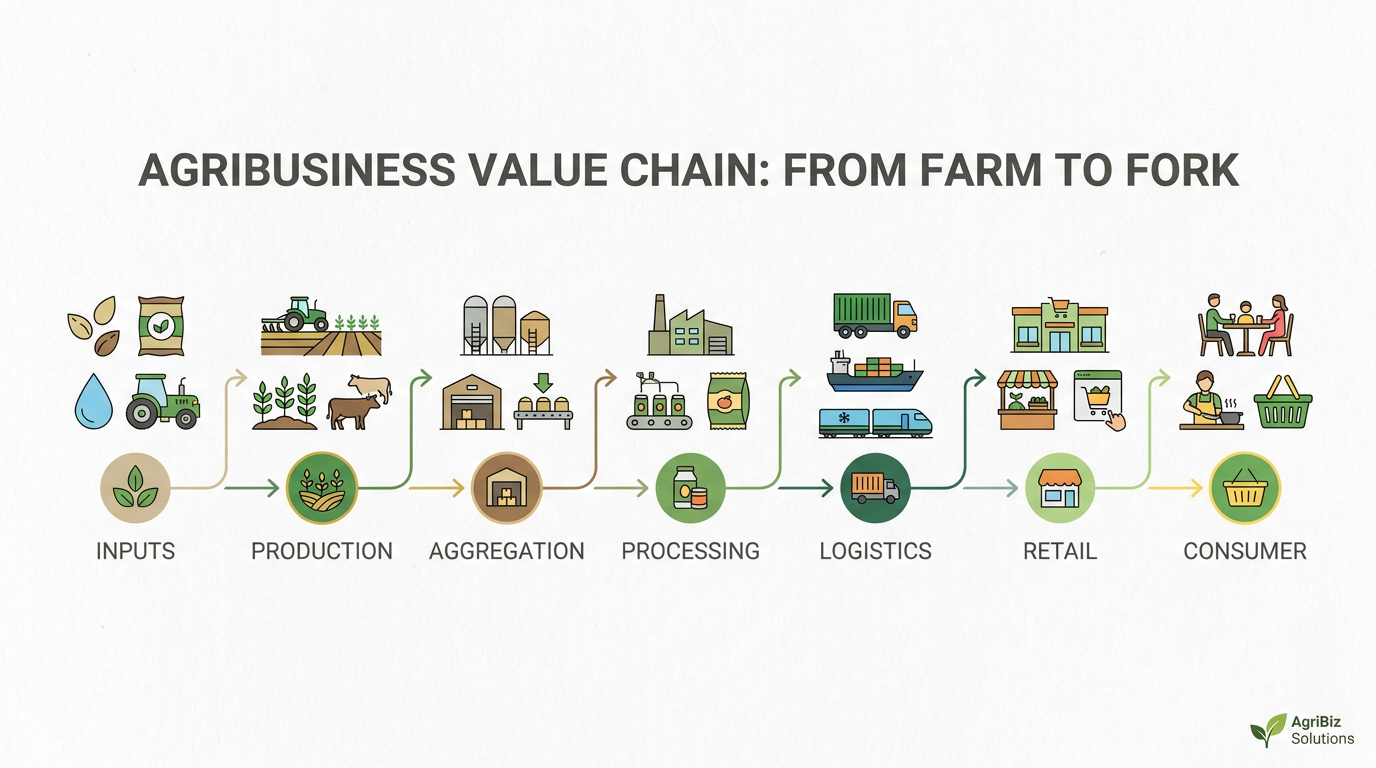
Agriculture focuses on production, while agribusiness includes the wider system of processing, finance, logistics, marketing, and retail.
This distinction matters because many early-career professionals think the field ends at the farm gate. In reality, some of the most important jobs, innovations, and business decisions happen after production – in post-harvest systems, distribution, value addition, branding, logistics, and finance.
What does agribusiness management include?
Agribusiness management includes a surprisingly wide range of commercial and operational functions. That is one reason it creates so many different career paths.
1. Production decisions
At the farm level, agribusiness management includes decisions about crop choice, inputs, water management, nutrition management, crop health, harvesting, post-harvest handling, and sales strategy.
These are not just technical choices. They are business choices because they affect costs, yields, quality, and profitability.
2. Technology and innovation
Modern agribusiness management also includes evaluating technologies such as digital agriculture tools, farm software, traceability systems, post-harvest technologies, processing innovations, logistics systems, and alternative food technologies.
The key question is not just “Is this new?” but “Does this improve productivity, profitability, resilience, or market access?”
3. Marketing and distribution
Agribusiness managers need to understand how products move from producer to buyer. That includes market channels, distribution strategy, customer segments, pricing, partnerships, retail requirements, food service demand, and export opportunities.
4. Post-harvest value addition
Sorting, grading, packaging, labeling, storage, and transportation all shape whether agricultural output becomes a profitable product. Many value gains – and many losses – happen here.
5. Business model design
One of the biggest shifts in modern agribusiness is the move from thinking only about production to thinking about the business model.
That means understanding the value proposition, the distribution strategy, key partnerships, sustainability elements, and the economics of profitability.
6. Finance and profitability
Agribusiness management also includes budgeting, accounting, margins, financing needs, working capital, value chain finance, and risk and return decisions.
A business may be technically impressive and still fail if it cannot manage cash flow, market timing, or financing structures.
What do agribusiness managers actually do?
The exact role depends on the organization, but in general, agribusiness managers make decisions that help agrifood businesses run efficiently and profitably.
Depending on the role, they may:
- coordinate procurement of farm inputs
- analyze market demand
- improve post-harvest systems
- manage supply chain operations
- oversee quality and compliance
- support distribution strategy
- evaluate agritech adoption
- build partnerships with producers or buyers
- assess profitability across a value chain
- manage budgets and reporting
- support sustainability initiatives
- design better commercial models
You can find agribusiness managers working in food companies, agritech start-ups, commodity trading firms, co-operatives, input companies, agricultural finance institutions, export businesses, distribution and logistics companies, development programs, farm-linked enterprises, and retail and food service supply operations.
In other words, agribusiness management is not one job title. It is a commercial capability that applies across the agrifood economy.
Why does agribusiness management matter?
The short answer is: because the food system is under pressure to do more, faster, and better.
Agribusiness today is being shaped by climate risk, input cost volatility, supply chain disruption, digital transformation, sustainability expectations, changing consumer demand, pressure for traceability and efficiency, and growing interest in regenerative and alternative food models.
That means organizations need professionals who can connect technical understanding with commercial judgment.
Agribusiness management matters because it helps businesses:
- improve productivity without losing sight of profitability
- respond to market demand more intelligently
- manage value chains rather than isolated steps
- adopt technology with a clear business case
- reduce waste and improve post-harvest outcomes
- build stronger partnerships across the chain
- make sustainability more commercially actionable
- understand where margins are created, protected, or lost
This is especially important in a global agrifood economy where success depends less on producing a commodity and more on managing relationships, quality, timing, logistics, differentiation, and market fit.
What skills are needed in agribusiness management?
A strong agribusiness professional needs more than technical agricultural knowledge. They need a mix of business, systems, and communication skills.
- Business thinking: understanding cost, margin, profitability, pricing, and commercial trade-offs
- Value-chain analysis: seeing how inputs, production, processing, logistics, finance, and retail fit together
- Market awareness: understanding customer demand, channel strategy, competition, and market positioning
- Operations and logistics understanding: knowing how food moves, where delays happen, and how quality and efficiency are maintained
- Financial literacy: reading basic numbers, understanding budgets, margins, and financing needs
- Technology evaluation: judging whether digital tools or innovations genuinely improve outcomes
- Problem-solving: weighing trade-offs in real-world conditions
- Communication and partnership building: coordinating across many actors in the agrifood system
For early-career professionals, this is good news. You do not need to know everything at once, but you do need a framework that helps you understand how the pieces connect.
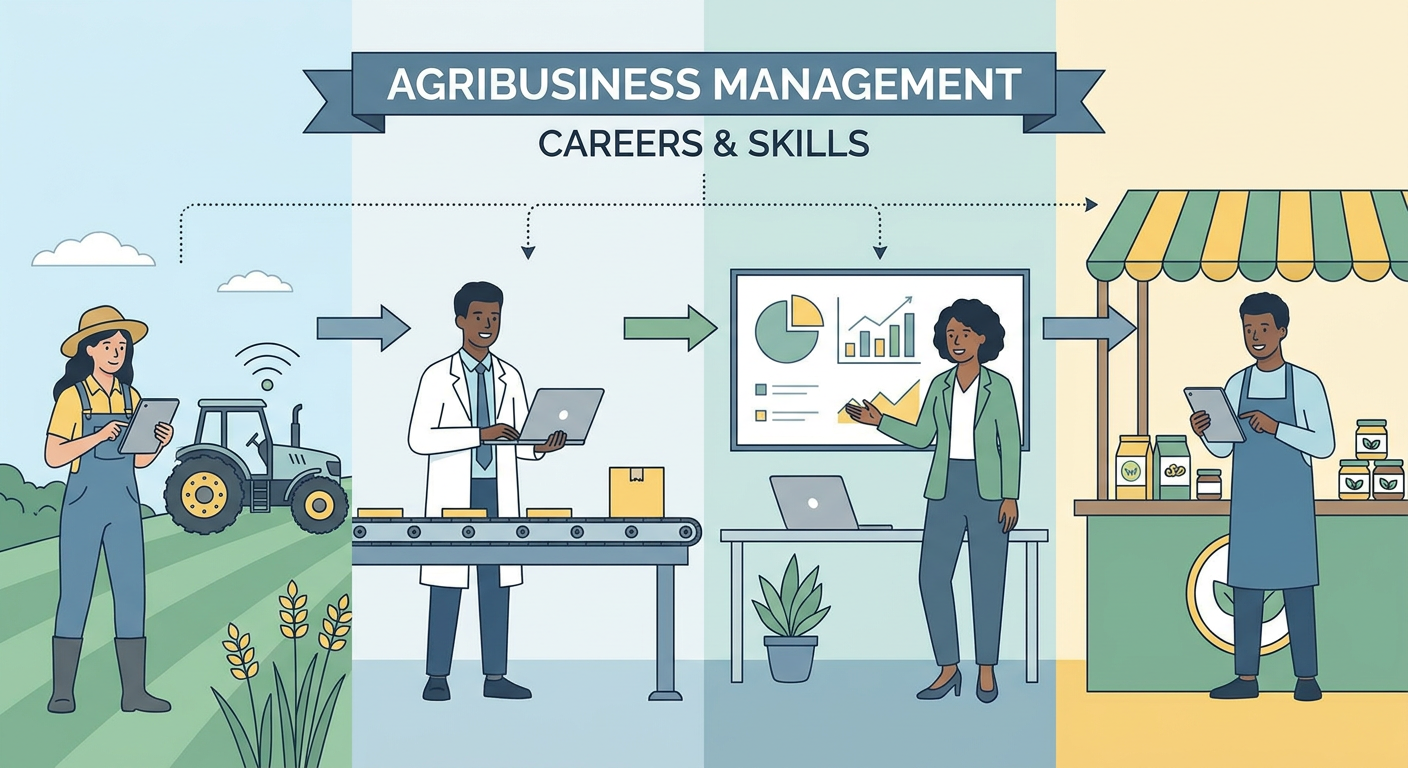
Agribusiness careers span operations, supply chains, food business, technology, finance, and market strategy.
What careers can you pursue in agribusiness management?
One reason people search for the agribusiness meaning is that they want to know whether the field offers real careers. It does – and they are broader than many expect.
Common career pathways include:
- agribusiness operations coordinator
- supply chain analyst
- procurement or sourcing associate
- marketing and distribution executive
- post-harvest or quality operations specialist
- business development associate
- agri-finance officer
- commodity or trade support analyst
- agritech commercial associate
- value chain project officer
- sustainability or sourcing coordinator
- food business entrepreneur
This is why agribusiness management appeals to agriculture graduates who want stronger business skills, community college students looking for career-ready specialization, early-career professionals who want to move beyond technical roles, and career switchers entering food and agriculture from business, logistics, or technology backgrounds.
The field rewards people who can think beyond a single function and understand how business decisions ripple through the entire system.
Why value chains matter in agribusiness management
If there is one idea that turns a basic understanding into a professional one, it is this: agribusiness is a value chain, not a single activity.
A value-chain lens helps you ask better questions:
- Who are the key actors?
- Who makes which decisions?
- Where is value added?
- Where does waste happen?
- Which partnerships matter?
- Which capabilities improve competitiveness?
- How does financing flow through the chain?
- What does the final market actually reward?
This perspective is increasingly important because agribusiness success depends on connection, not isolation. A farmer may produce excellent output, but if distribution is weak, packaging is poor, quality control fails, or financing is unavailable, value is lost.
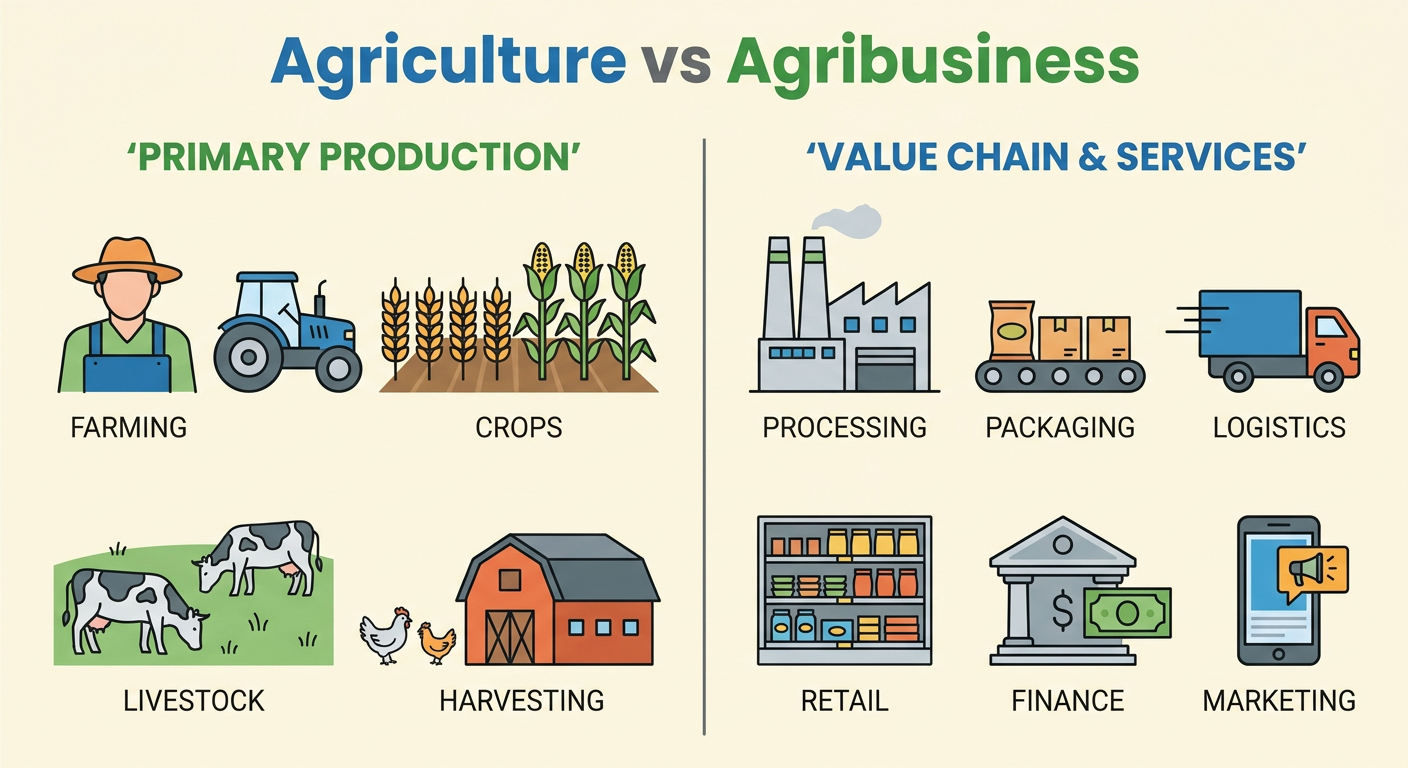
A value-chain view helps explain where value is created, moved, and sometimes lost across the agrifood system.
That is why structured learning in agribusiness value chains is so useful. It helps learners move from seeing individual tasks to understanding the business architecture behind the entire agrifood system.
How do you start learning agribusiness management?
Many people assume they need a full university degree in business or agriculture before they can understand agribusiness management. That is not always true.
What most learners need first is a clear, applied framework.
A good starting point should help you understand:
- how farms make production decisions
- how agritech changes business models
- how marketing and distribution work
- how post-harvest systems affect profitability
- how food and agriculture business models are designed
- how trends like digital agriculture, regenerative systems, and alternative foods are changing the sector
- how accounting, finance, and value chain financing support decision-making
That is exactly why structured professional learning options are becoming more relevant. For learners who already have technical exposure, work experience, or strong interest in the sector, a focused certificate can be a practical bridge between general knowledge and job-ready understanding.
Build practical agribusiness skills with a value-chain lens
If you want to move from understanding agribusiness management to applying it, explore IFAL’s Foundation Certificate in Agribusiness Value Chains.
The program is designed for early-career professionals, community college graduates, and career switchers. It covers production decisions, agritech, marketing and distribution, profitability, business models, and value chain finance in a structured online format.
You can also explore the AI Agribusiness Coach for additional guided support.
Frequently asked questions
What is agribusiness management in simple words?
Agribusiness management is the business side of food and agriculture. It means managing the activities that help agricultural products move from inputs and farms to processors, markets, retailers, and consumers.
What is the difference between agribusiness and agriculture?
Agriculture mainly focuses on growing crops and raising livestock. Agribusiness includes agriculture plus the wider system of input supply, processing, packaging, logistics, marketing, finance, and retail.
What do agribusiness managers do?
Agribusiness managers help organizations make better decisions about operations, markets, distribution, technology, profitability, partnerships, and value-chain performance.
Is agribusiness management a good career?
Yes. Agribusiness management can be a strong career path for people interested in food systems, business, supply chains, technology, sustainability, and market strategy.
What skills do you need for agribusiness management?
Key skills include business thinking, value-chain analysis, communication, operations understanding, market awareness, financial literacy, and problem-solving.
Can you learn agribusiness management online?
Yes. Many learners begin through online certificates, industry programs, or applied professional learning pathways that explain how agrifood businesses work across the value chain.
Why are value chains important in agribusiness?
Value chains show how value is created, moved, lost, or improved across the agrifood system. They help professionals understand the relationships between production, processing, logistics, finance, and final markets.
Final takeaway
So, what is agribusiness management?
It is the discipline of making food and agriculture work as a business system.
It is about more than farming. It is about the full chain of decisions that connects inputs, production, post-harvest handling, processing, finance, logistics, markets, and consumers. It is about understanding where value is created and how businesses can compete, grow, and adapt in a changing agrifood economy.
For students, early-career professionals, and career switchers, that understanding can be a real advantage. The more the food system changes, the more valuable it becomes to think in value chains rather than isolated tasks.
And that may be the clearest way to understand agribusiness management: it is the skill of seeing the whole system – and helping it work better.