Why Agribusinesses Must Embrace Value Chain Thinking — Not Just Farming
Want to grow beyond the farm and build a scalable, sustainable agribusiness?
Start with the Mini MBA in Food & Agribusiness — a practical program to help professionals master business models, value chains, and strategic growth.
In Indian agribusiness, most conversations still revolve around what’s happening on the farm — from seed choice and soil health to irrigation and crop yield. And while these are undeniably important, farming alone cannot unlock the full potential of Indian agriculture.
To truly create wealth, build sustainable brands, and improve farmer incomes, agribusinesses must embrace value chain thinking.
It’s not just about growing more. It’s about managing, adding, and capturing value — at every stage from farm to fork.
This mindset shift is what separates the local trader from the national food brand. The FPO that just survives from the one that scales with impact. The startup that burns out, from the one that leads.
 What is Value Chain Thinking?
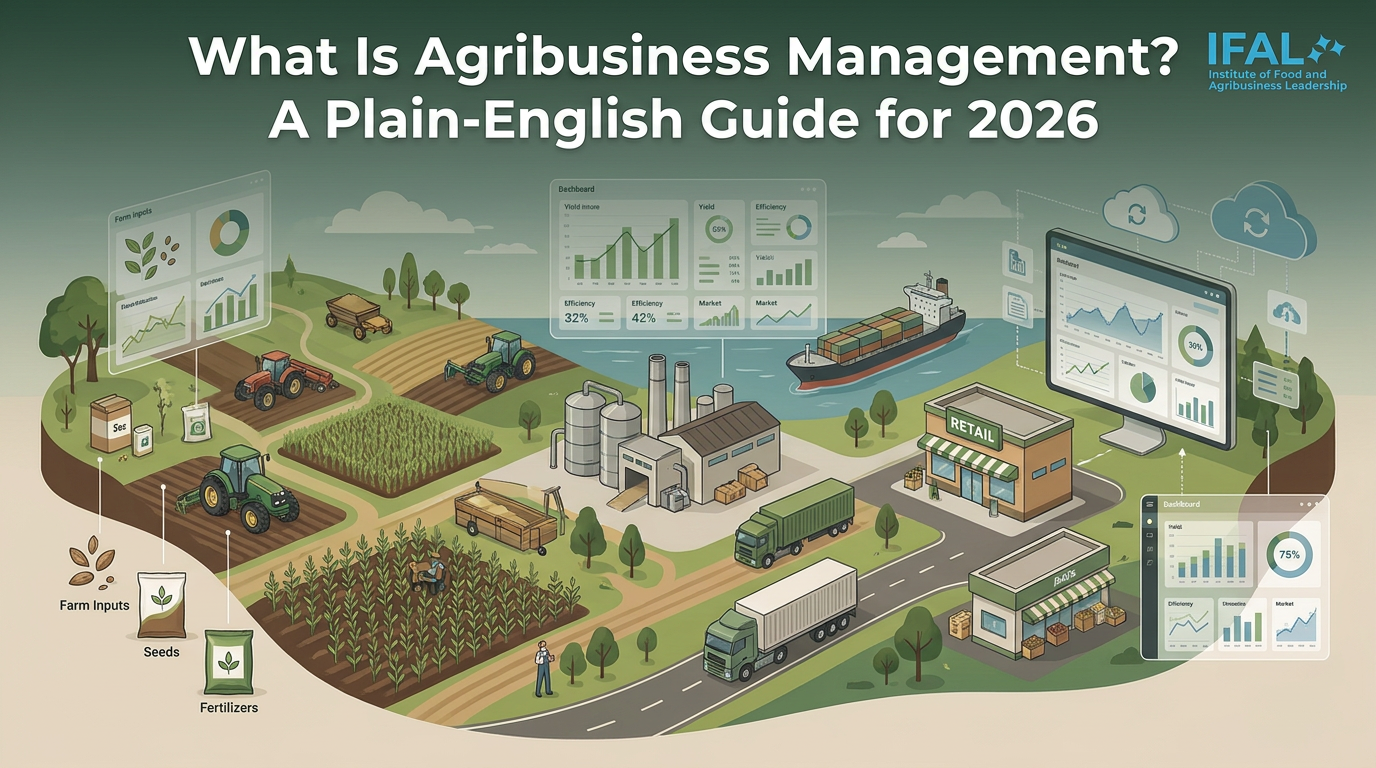
Value chain thinking means understanding how value is created, lost, or captured at every stage — from inputs and farming, to processing, logistics, packaging, branding, and final delivery.
It requires stepping back from a “farm-first” or “siloed” view and asking:
Where is the real margin in this chain?
Who influences the pricing and perception of the product?
What stages are inefficient or broken?
How can we collaborate to fix them?
But here’s the powerful insight:
You don’t need to manage the entire chain — you just need to understand it deeply and focus on the right link.
 Why a Farm-Only Approach Falls Short
Even the most productive farms suffer if:
They’re stuck selling to middlemen or mandis.
Their crops perish due to poor storage or lack of buyers.
They don’t connect to brands or processors who add real value.
A purely farm-centric approach often leads to:
Limited market access
Low price realization
Zero influence over branding or consumer experience
You might win at growing — but lose at selling.
To avoid this, agribusinesses need to expand their lens from production to the full value chain.
 Case Examples: How Focused Value Chain Thinking Drives Success
 iD Fresh Food — Dosa Batter, Mastered
Focused only on fresh batter for urban Indian homes.
Built strong sourcing, cold-chain, and D2C capabilities.
Didn’t try to do farming or retail — partnered smartly.
Now scaling across products and geographies.
 WayCool — India’s Supply Chain Backbone
Built a farm-to-retail supply chain platform.
Offers services to farmers, processors, and buyers.
Focused on data, tech, and execution — not branding or production.
Became a backbone player for others in the chain.
 Farmley — Quality Dry Fruits, Delivered
Chose a high-value niche: dry fruits and healthy snacking.
Focused on sourcing, quality control, and digital marketing.
Outsourced non-core operations early on.
Built a fast-scaling D2C brand with loyal consumers.
What Value Chain Thinking Really Means (And Doesn’t)
| What It Is | What It’s Not |
|---|---|
| Understanding how value flows from farm to fork | Trying to control everything |
| Building deep expertise in one value chain segment | Being a generalist without focus |
| Partnering to fill gaps | Avoiding collaboration |
| Solving problems across the chain | Working only in silos |
Embracing value chain thinking means playing your role brilliantly, while building strong partnerships to strengthen the rest.
 The Right Way to Adopt Value Chain Thinking
Map the Entire Chain
Know who’s involved from inputs to exports.Identify Your Strength
Are you great at sourcing, processing, advisory, or branding?Spot the Gaps
Where do you struggle — logistics, cold chain, packaging, retail?Build Complementary Partnerships
Work with those who are strong where you’re not.Create Shared Value
Align incentives with partners — farmers, processors, marketers — so everyone benefits.
 Final Thoughts
Agribusiness in India is evolving — and it demands more than just farm-level thinking.
Success now belongs to those who can see the whole picture, build depth in their niche, and collaborate to close the loop.
Whether you’re in input distribution, working with an FPO, running a food brand, or launching a startup — value chain thinking is your strategic edge.
You don’t need to own the full value chain.
You need to understand it, position yourself smartly, and partner wisely.
That’s how modern agribusinesses win.
Take the Next Step
If you’re ready to advance your career in food and agribusiness:
Explore Avila University’s Agribusiness Certificate Programs
Identify the certificate that aligns with your career stage
Connect with admissions advisors to plan your learning pathway
Learn more:
https://www.avila.edu/avila-agribusiness-programs/