How AI is Transforming Food Safety & Quality Control in 2025
Real-World Case Studies | Supply Chain Impacts | Strategic Insights
 Why Traditional Food Safety Systems Are Failing
Food safety has always been high-stakes, but today, it’s also high-tech. With global supply chains growing more complex and foodborne illnesses still affecting 600 million people annually (WHO), relying on manual inspections, batch testing, and reactive recalls just doesn’t cut it anymore.
What the industry needs is real-time intelligence, predictive capabilities, and systemic transparency. That’s exactly what Artificial Intelligence (AI) is delivering.
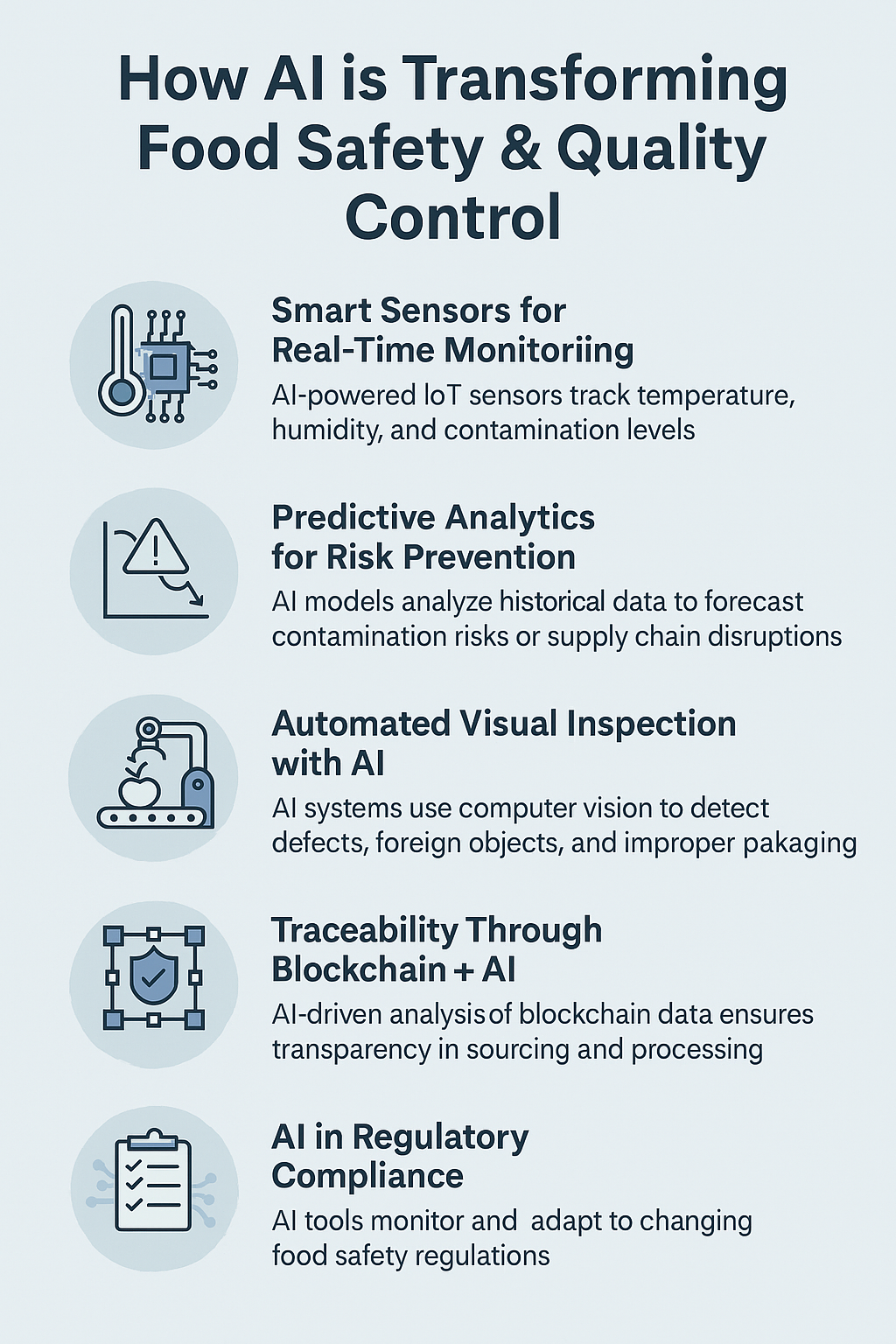
 How AI is Revolutionizing Food Safety: 2025 Snapshot
1. Smart Sensors for Real-Time Monitoring
AI-integrated IoT devices can monitor temperature, humidity, and microbial contamination throughout storage and transport.
 New: Seaqure Labs (via FoodTech Weekly)
Seaqure Labs develops AI biosensors for aquaculture, capable of detecting pathogens in real-time. This tech has strong crossover potential for processing plants to prevent microbial outbreaks early.
Insight: AI biosensing is extending food safety innovations beyond factories—upstream into farming and aquaculture.
2. Predictive Analytics for Risk Prevention
AI algorithms analyze historical and real-time data to anticipate risks like contamination or temperature deviations.
Case Study: IBM Food Trust
Combining blockchain with AI, IBM enables predictive shelf-life monitoring and contamination risk alerts for packaged food brands.
3. Automated Visual Inspection with AI
Computer vision systems powered by AI now monitor production lines 24/7, identifying defects, spoilage, or labeling errors instantly.
Case Study: Nestlé
Nestlé implemented AI-powered vision tools in chocolate plants to inspect wrapper integrity and fill levels.
4. Traceability Through Blockchain + AI
Combining traceability tech with AI allows food companies to track product movement down to seconds—essential during contamination events.
Case Study: Walmart + IBM
Walmart uses IBM’s blockchain + AI system to trace leafy green origins in 2.2 seconds (compared to 7 days before).
5. AI in Regulatory Compliance
Meeting FSMA, Codex, or GFSI standards requires consistent data logging and verification. AI systems now automate much of this.
Case Study: Clear Labs
Clear Labs uses AI for microbial testing and generates automated compliance reports aligned with U.S. and EU food safety standards.
6. Preventive Safety with AI in Production Agriculture
Safety doesn’t start at the factory. AI is now being used in upstream agri-inputs to reduce food contamination risks before harvest.
New: Agragene (via FoodTech Weekly)
Agragene’s AI-enhanced CRISPR technology is used to reduce pest pressures in crop production—minimizing pre-harvest contamination and mycotoxin risks.
 Strategic Benefits of AI in Food Safety
Integrating AI into your food safety system gives you:
- Real-time alerts and control
- Reduced product recalls
- Enhanced consumer trust via traceability
- Better resource planning and reduced food waste
- Automated compliance aligned with global standards
 Implications for Supply Chain Leaders
Food safety is now a data challenge and a strategic opportunity. Whether you’re sourcing raw materials or managing retail risk, AI helps you:
Build resilient supply chains
Make faster, data-informed decisions
Move from compliance to competitive advantage
But you need people who understand the tech and the system.
 Want to Lead in AI-Driven Food Innovation?
The future belongs to those who can combine technology with strategy. That’s exactly what our Mini MBA in Food & Agribusiness delivers.
Through this program, you’ll learn how to:
Design AI-enhanced supply chains
Evaluate new technologies like blockchain, IoT, and biosensors
Drive change through systems thinking and real-world problem-solving

 Key Takeaways
AI is transforming food safety from reactive to predictive and proactive.
Case studies from TOMRA, Nestlé, Walmart, Seaqure Labs, and Agragene show diverse AI use-cases.
Food leaders must combine tech fluency with strategic vision to stay ahead.
The Mini MBA in Food & Agribusiness equips you to lead this transformation.
 References
WHO – Foodborne Disease Burden: https://www.who.int
TOMRA Food: https://www.tomra.com/food
IBM Food Trust: https://www.ibm.com/blockchain/solutions/food-trust
Walmart Blockchain Case: Forbes Article
Nestlé Digital Quality Control: https://www.nestle.com
Clear Labs: https://www.clearlabs.com
Seaqure Labs Interview: FoodTech Weekly, Issue #161 (Mar 13, 2025)
Agragene Interview: FoodTech Weekly, Issue #160 (Mar 6, 2025)