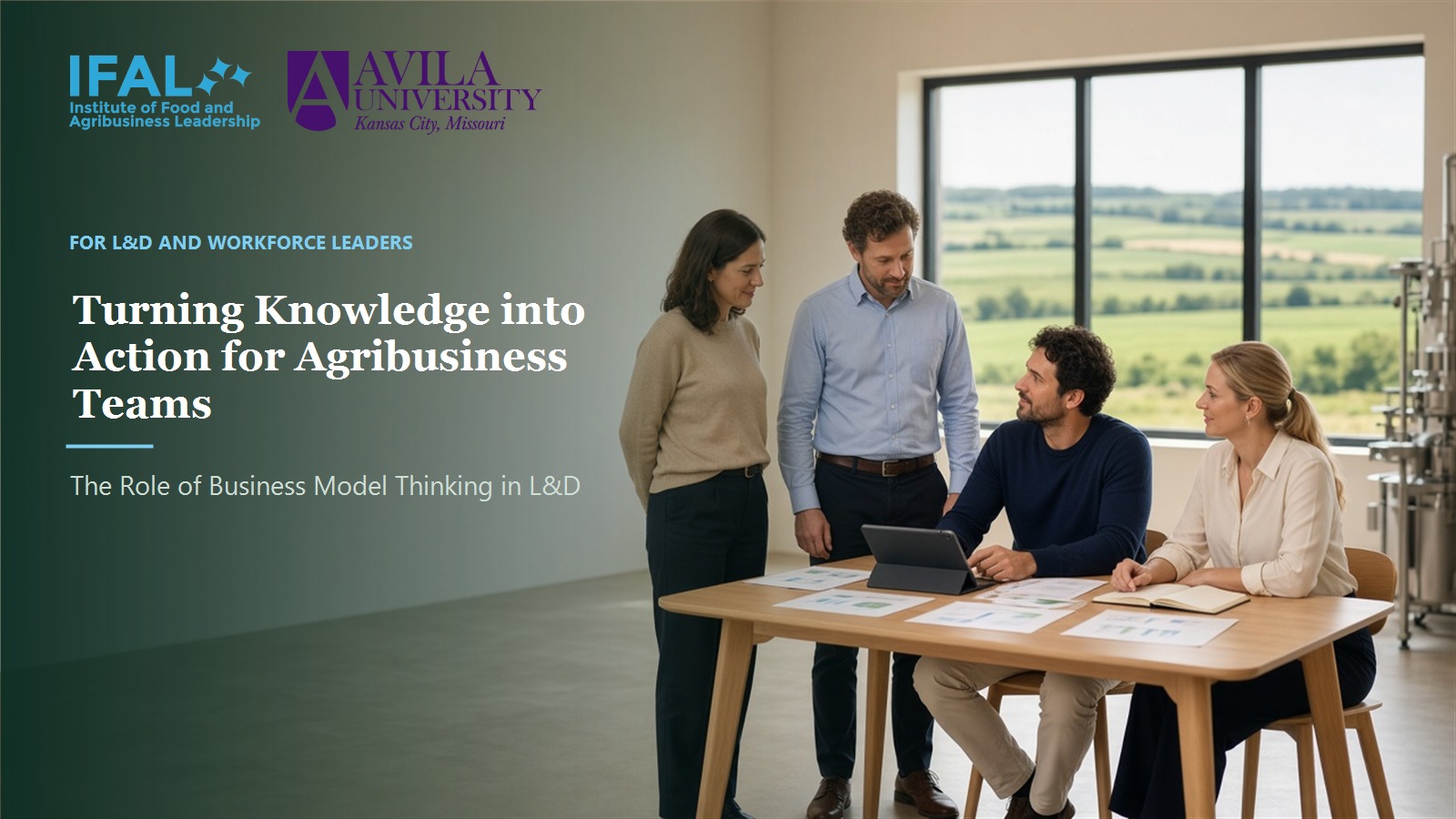
Turning Knowledge into Action for Agribusiness Teams: The Role of Business Model Thinking in L&D
Quick answerBusiness model thinking gives an agribusiness L&D team one shared way to describe how the business creates, delivers, and captures value. Run it as a one-hour review on a live account, using four questions: value proposition, distribution, partnerships, and sustainability.
A food manufacturer runs a quarterly planning meeting. Procurement talks about landed cost. R&D talks about a reformulation that scored well in panel tests. The supply chain coordinator talks about a carrier that keeps missing windows. Sustainability talks about a buyer questionnaire that needs answering by Friday. Everyone in the room is competent. Everyone has been trained. And yet four people describe the same customer four different ways, so the meeting ends with actions but no decision.
If you own learning and development for an agribusiness, that meeting is your brief. The problem is rarely a shortage of training. It is that functional training builds depth inside each role and leaves the layer above it empty: a shared account of how the business actually creates, delivers, and captures value. That layer belongs to nobody in particular, so no department buys it, and the gap stays open.
This article is about closing it with business model thinking — and about doing it as a working session your team can run this month, not a course you have to wait for.
What you will learn
- Why strong technical training still leaves teams misaligned in planning meetings
- The difference between agriculture skills and agribusiness judgment, and why L&D should care
- The four components that give a cross-functional team one shared language
- How to run a one-hour business model review on a live account
- What to show a sponsor who asks what the training changed
The gap is commercial, not technical
Agriculture is production: growing crops, raising livestock, managing soil, water, and inputs. Agribusiness is production plus everything that connects production to a market — input supply, processing, packaging, logistics, distribution, finance, and retail. Most people working in the sector were trained for the first and are paid to make decisions in the second. Our plain-English guide to agribusiness management sets out that distinction in full.
IFAL's programme pages put a number on the consequence: only 18% of agribusiness employers report that new graduate hires are commercially ready on day one, citing the USDA and Purdue University 2025–2030 Agribusiness Employment Outlook. For an L&D function, the useful reading of that figure is not that hiring is broken. It is that commercial judgment is a trainable capability that almost nobody arrives with, and almost no functional curriculum covers.
Why function-level training leaves the gap open
The pattern repeats across the sector, as we set out in why value chain thinking is the new competitive advantage:
- Agronomists understand production, but not always markets.
- Supply chain teams optimise logistics, but not always sourcing strategy.
- Founders and commercial managers build products, but often struggle with distribution and scale.
Each of those is a well-trained professional. The cost shows up between them: fragmented decisions, missed opportunities, and margin that leaks at the handover points nobody owns. Value in agribusiness is not created inside a function. It is created across the chain, which means the capability you are missing is also cross-functional.
One framework, four questions, shared across the team
Business model thinking gives a mixed group one structure to argue inside. The framework used throughout IFAL's curriculum has four components, and their value to L&D is that each one is a question a team can answer out loud about its own business:
- Value proposition. Who exactly is the customer, what problem are we solving, and why do they choose us over the alternative?
- Distribution strategy. Is the route to market built around the value we deliver, or is it the channel that was easiest to set up years ago?
- Complementary chain partnerships. Are our capability gaps filled on purpose, or by accident?
- Sustainability components. Is durability designed into the model, or bolted on afterwards as a compliance line item?
Original diagram, Institute of Food and Agribusiness Leadership. The same four components are in the free ebook.
None of this replaces technical or functional training. It sits above it. That is the point: it is the layer that makes the rest of your training investment add up to something coherent across teams, instead of four departments each optimising their own piece in isolation. We made the same argument for employers in a free agribusiness workforce training resource; this piece is about what an L&D lead does with it on a Tuesday.
Turn the framework into an hour on a live account
Industry readiness is the ability to step into a role and deliver value, not the ability to complete a module. Our article on the role of industry readiness in agri-food careers makes that case for graduates. The same test applies to a team already on your payroll: knowledge that never reaches a decision is not readiness.
So run it as a session rather than a syllabus.
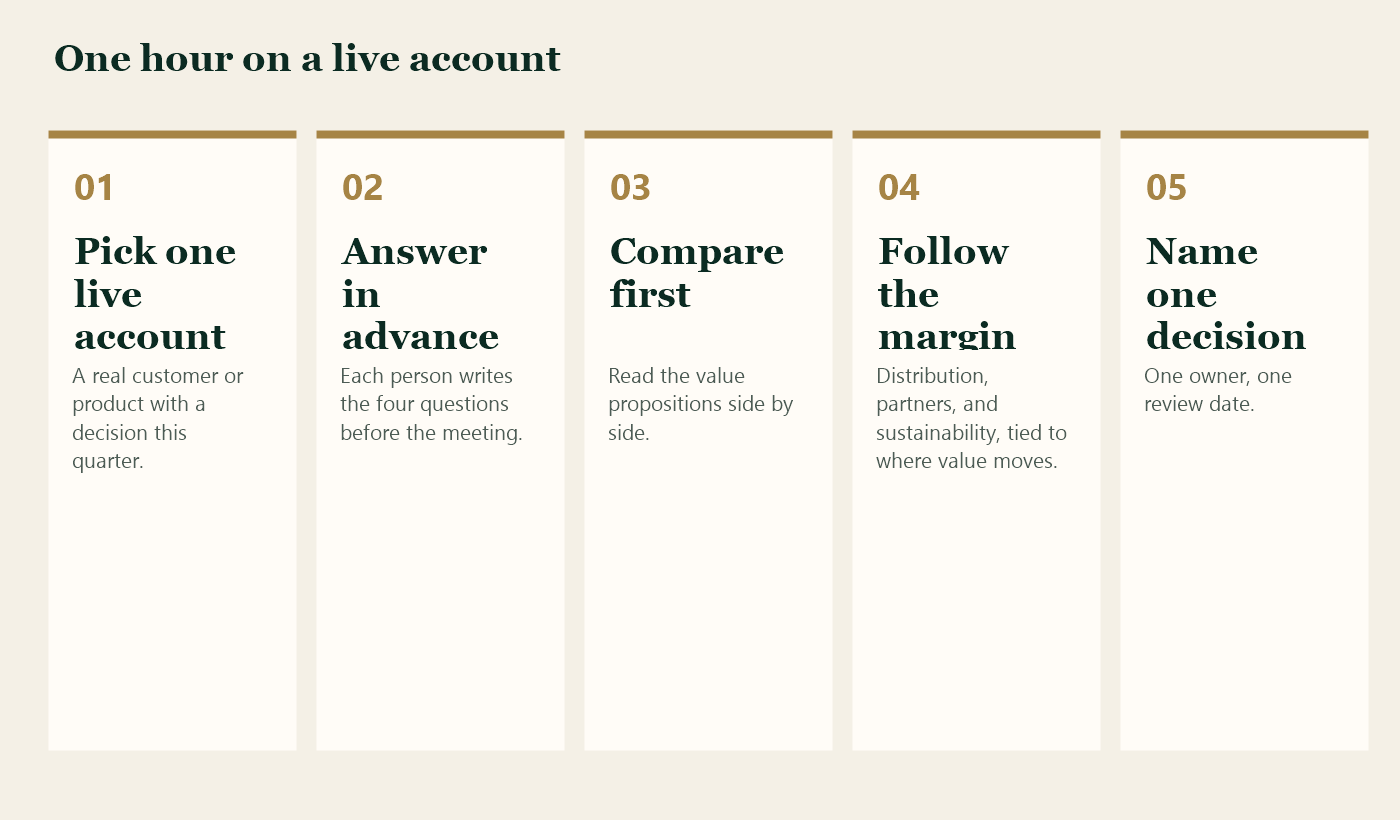
- Pick one live account. A real customer, supplier, or product line with a decision pending this quarter. Hypothetical cases let everyone stay polite.
- Send the four questions in advance. Ask each participant to answer all four from their own vantage point, in writing, before the meeting. Ten minutes each is enough.
- Compare the answers first. Read the four versions of the value proposition side by side. The disagreement in that first ten minutes is the finding — it is the misalignment that normally stays invisible until a plan fails.
- Work through distribution, partnerships, and sustainability in turn. Keep one rule: every claim has to connect to where margin is created, protected, or lost.
- Close on one decision. Name a single thing the team will do differently, who owns it, and when it will be reviewed. One decision beats a page of insights.
Repeat it monthly with a different account and a different mix of functions. The framework is the constant; the business is the content. That is what makes it cheap to run and hard to forget.
What changes when business model thinking lands
The shift is a change in the questions people ask unprompted. Donné van Schoor, a food science graduate who moved from factory-floor product development into value chain work, described it this way after structured business model study:
"Before, I would look at a company and just see the surface. Now I find myself asking: What's their business model? Are they aligning sourcing, people, and product with strategy? That mindset shift alone is invaluable."
From Product Developer to Strategic Thinker
The cost of the absent version is just as visible. Del Monte Foods, a trusted household brand since 1886, filed for Chapter 11 in July 2025 after expanding production on pre-pandemic demand expectations while consumers moved towards fresh, minimally processed, clean-label options. No part of that failure was technical. It was a value proposition and a distribution strategy that stopped matching the market, and a business that kept executing well against the wrong model. Our business model analysis of Del Monte walks through all four components, which makes it a useful case to put in front of a team that thinks strategy is somebody else's job.
How to show your sponsor it worked
Training spend is hard to defend when the return is fuzzy, and harder still when different teams leave the same programme speaking different languages. Business model thinking is more defensible than generic upskilling because the outcomes are observable in the work:
- Fewer cross-functional misunderstandings inside planning cycles
- Faster alignment when a channel, price, or sourcing question comes up
- Less time spent re-litigating strategy decisions a shared framework should have settled
- A record of concrete decisions, one per session, traceable to the review that produced them
Those four lines are a reporting format as much as a benefits list. Log the decision from every session and you have the evidence conversation ready before anyone asks for it.
Where structured study fits after the session
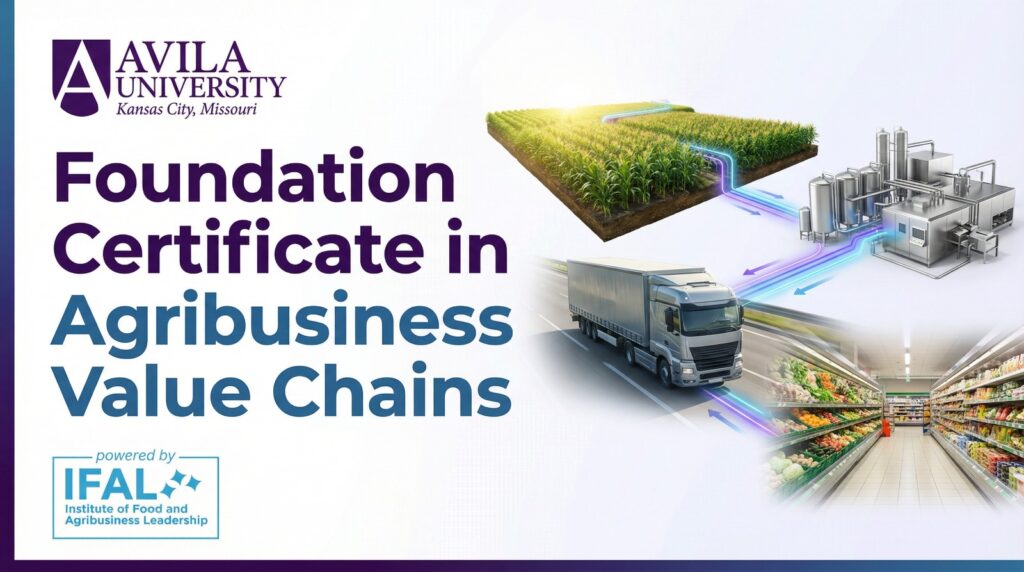
The session surfaces the gap. Some of your team will want the full framework, and that is where a structured programme earns its place. IFAL's Foundation Certificate in Agribusiness Value Chains is 14 courses and roughly 45 hours, self-paced, AI-coached, and co-credentialed with Avila University (HLC-accredited, Kansas City), covering production decisions, agritech, marketing and distribution, profitability, business model design, and value chain financing. For L&D functions it is deployable across a cohort rather than one learner at a time, with completion tracking for the people who sign off the budget.
Start with the session, though. Capability you can demonstrate is easier to fund than capability you have to promise.
Final takeaway
Your team's technical knowledge is not the constraint. The constraint is that nobody has given them one shared way to describe how the business makes money, so every cross-functional conversation starts from scratch. Business model thinking is the cheapest fix available to an L&D function, because it reuses the business you already have as the case material.
Before you schedule the first session, read Food and Agriculture Business Models. It is free and needs no signup to start, it is built from 15+ years of research across 300+ business models in more than 30 countries, and it works through the same four components on real operators: Honing Tomaten, a Dutch tomato grower that rebuilt itself around a sharper value proposition and turned rejected fruit into its own ketchup line; What Chefs Want!, a distributor that grew from a single produce van in Louisville to serving more than 16,000 restaurants by doing the opposite of the national broadliners; and ProducePay, a platform financing fresh produce growers that traditional agricultural lending underserved. Read one case, then put the four questions on your own biggest account and see how far your team agrees.
Frequently asked questions
Is business model thinking a replacement for technical training?
No. It sits above functional and technical training and makes it cohesive. Your quality, agronomy, and logistics curricula still do their jobs; the business model layer is what lets four functions reach one decision.
Who should be in the room for a business model review?
Mix functions deliberately: commercial, procurement, operations or supply chain, and whoever owns sustainability reporting. Five to eight people is enough. The value comes from the differences between their answers.
How long before an L&D lead sees anything measurable?
The first session produces an observable output immediately, because it ends in a named decision. Pattern-level change — faster alignment, fewer repeated strategy arguments — typically shows up across a planning cycle rather than a week.
Does this work for experienced staff, or only new hires?
Both, and often the experienced group gets more from it. Most people in agribusiness learned the commercial side informally on the job and have never had the structure made explicit. Long tenure is not the same as a shared framework.
What preparation does the facilitator need?
Enough fluency to hold the four components steady when a conversation drifts into operational detail. Reading the business model framework with worked examples before you facilitate is usually sufficient.
Can we run this without buying anything first?
Yes. The four questions, one live account, and an hour on the calendar are the whole method. The reading below is free to start.
Free to start. No signup.
Read the ebook
15+ years, 300+ business models, 30+ countries. The same four components, on real agrifood companies.