What Is Agribusiness? Understanding the Business Behind Agriculture
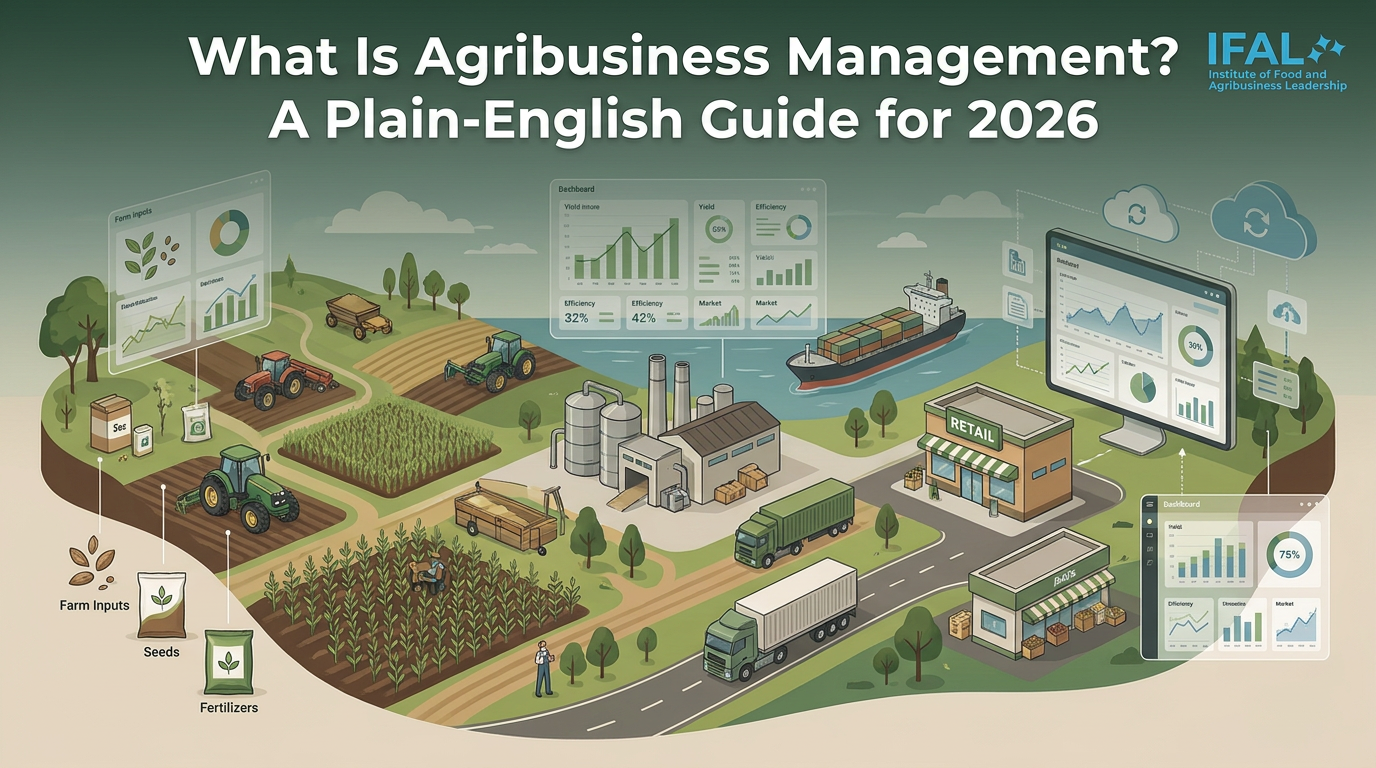
Agribusiness is much bigger than farming alone. It includes the entire commercial system that makes agriculture work, from seeds and fertilizers to logistics, processing, distribution, and retail. If agriculture grows food, agribusiness is the wider system that turns production into value, markets, and livelihoods.
Table of Contents
Executive Summary
When many people hear the word agriculture, they think of farms, fields, tractors, livestock, and harvests. But agribusiness is broader than that. It includes all the businesses and systems that support agricultural production and connect it to final consumers.
In simple terms, agribusiness covers input suppliers, farmers, traders, processors, transporters, exporters, retailers, banks, insurers, and technology providers. Farming is one part of agribusiness, but not the whole picture.
This broader understanding matters because modern food systems depend on coordination across an entire chain. Food is no longer just grown and consumed locally. It is financed, processed, packaged, moved, marketed, branded, and sold through increasingly complex systems.
Introduction
Think about a tomato on a supermarket shelf. It may have started as a seed developed by a breeding company. It was grown by a farmer using fertilizer, irrigation, machinery, labor, and credit. Then it may have been sorted, packed, transported, processed, or sold fresh to a retailer. By the time it reaches the consumer, many businesses have played a role.
That journey is agribusiness.
Agribusiness helps us understand that agriculture is not just production. It is an interconnected system of economic activity. Farmers depend on upstream suppliers and downstream markets. Consumers depend on agribusiness for food quality, safety, and availability. Rural economies depend on it for jobs, income, and investment.
Core Concepts and Definitions
What is agribusiness?
The term agribusiness was popularized by John Davis and Ray Goldberg at Harvard Business School in 1957. They described it as the sum total of all operations involved in the production and distribution of food and fiber.
Agribusiness is the network of businesses and activities involved in supplying agricultural inputs, producing crops and livestock, processing raw materials, storing and transporting products, financing operations, and marketing food, fiber, and bio-based products to final users.
Main components of agribusiness
- Input supply - seeds, fertilizers, chemicals, machinery, irrigation, finance, insurance, and advisory services
- Primary production - crop farming, livestock, fisheries, and forestry
- Aggregation and trading - collection, grading, storage, and commodity marketing
- Processing and manufacturing - milling, slaughtering, packaging, preservation, and food processing
- Logistics and distribution - warehousing, transport, cold chains, and export systems
- Marketing and retail - supermarkets, restaurants, wholesalers, food service, and consumer sales
Agribusiness is not the same as farming
This distinction is critical:
- Farming focuses on production itself: planting, cultivating, raising livestock, and harvesting.
- Agribusiness includes farming plus all the commercial systems around it.
A fertilizer company is part of agribusiness. A grain trader is part of agribusiness. A dairy processor is part of agribusiness. A supermarket chain sourcing fresh produce is part of agribusiness.
In-Depth Analysis
Agribusiness as a value chain
One of the most effective ways to understand agribusiness is through the idea of a value chain. A value chain explains how value is created and captured from the earliest input to the final consumer product.
In agriculture, this means understanding the journey from seed, feed, and fertilizer to production, storage, processing, transport, branding, and retail.
Why agribusiness is different from other industries
Agribusiness is shaped by biology. Crops grow according to seasons, livestock mature over time, and both are vulnerable to weather, pests, and disease. Unlike factories, farms cannot always accelerate output on demand.
This creates distinctive business challenges:
- seasonal production cycles
- perishability of products
- quality variability
- supply volatility
- high exposure to climate and natural risk
Because of this, agribusiness depends heavily on coordination, storage, timing, logistics, insurance, and risk management.
Where value is created and captured
One of the most important insights in agribusiness is that the place where value is created is not always the place where value is captured. Farmers create biological value by growing crops and raising animals, but many downstream actors capture large shares of the final price.
For example, wheat becomes flour, flour becomes bread, and bread becomes a packaged branded product. At each stage, value is added through processing, packaging, branding, transport, and retail presentation.
This is why agribusiness is about much more than yields. It is also about strategy, positioning, and value addition.
Expert Perspectives
Several important schools of thought help explain agribusiness:
- The Harvard perspective introduced the idea of agriculture as an integrated business system rather than an isolated production activity.
- The value chain perspective shows how food systems evolve as processing, logistics, modern retail, and food service expand.
- The development perspective highlights the role of agribusiness in rural transformation, employment, poverty reduction, and food security.
- The modern strategic perspective adds digital tools, sustainability, traceability, resilience, and ESG considerations.
Together, these perspectives show that agribusiness is a system shaped by economics, biology, infrastructure, policy, and consumer demand.
Real-World Applications
Case 1: The maize chain
A maize farmer may buy seed and fertilizer from an input supplier, grow the crop, sell it to a trader, who then supplies a miller. The miller processes the maize into flour, which is packaged and distributed to wholesalers and shops. Every stage in that chain is agribusiness.
Case 2: The dairy chain
Milk depends on feed supply, veterinary services, collection centers, cooling systems, processors, packaging companies, and distributors. Without these systems, fresh milk would spoil quickly and fail to reach urban consumers in safe condition.
Case 3: Export horticulture
Fresh fruit and vegetable exports often require contract farming, certification, traceability, packhouses, cold chains, customs compliance, and global logistics. This is agribusiness operating at a high level of coordination.
Case 4: Agritech-enabled systems
Modern agribusiness increasingly includes digital platforms, remote sensing, mobile payments, AI-based advisory tools, and traceability software. This shows how agribusiness now combines physical value chains with data-driven systems.
Historical Context
Agribusiness emerged as agriculture became more commercial, urban-linked, and industrialized. In earlier economies, many households produced much of what they consumed. Processing happened at home, markets were shorter, and fewer specialized intermediaries existed.
Over time, several forces transformed this:
- urbanization increased the distance between producers and consumers
- income growth changed diets and increased demand for convenience foods
- processing and packaging industries expanded
- cold chains and transport networks improved
- supermarkets and food service channels grew
- private standards and certification systems became more important
As a result, food systems evolved from local production systems into longer, more specialized, and more business-intensive chains.
Future Outlook
Agribusiness is changing quickly. Several major trends are shaping its future:
- Digital transformation through farm management software, analytics, and remote sensing
- Sustainability pressure from regulators, investors, and consumers
- Climate adaptation as businesses respond to increased production volatility
- Supply chain resilience through better storage, sourcing flexibility, and risk management
- Traceability and standards as buyers demand proof of quality, safety, and origin
- Professionalization as agribusiness requires stronger capabilities in finance, trade, logistics, and operations
The future of agribusiness will belong to organizations and professionals who can connect production knowledge with business strategy, systems thinking, and market awareness.
Key Takeaways
- Agribusiness is broader than farming.
- It includes the full system from inputs to final consumer markets.
- Modern food systems depend on agribusiness coordination.
- Much of the value in agriculture is created after the farm gate.
- Agribusiness is shaped by biology, infrastructure, markets, and technology.
- Understanding value chains is essential for success in agribusiness.
- Professional learning in agribusiness value chains can provide a strong career advantage.
Frequently Asked Questions
Q: What is the simplest definition of agribusiness?
A: Agribusiness is the business system around agriculture, including input supply, farming, processing, storage, transport, finance, marketing, and retail.
Q: Is agribusiness the same as agriculture?
A: No. Agriculture refers mainly to production, while agribusiness includes production plus all connected commercial activities.
Q: Why is agribusiness important?
A: It connects farms to markets and helps ensure food reaches consumers efficiently, safely, and profitably.
Q: What careers exist in agribusiness?
A: Careers include farm management, commodity trading, food processing, logistics, export management, finance, quality assurance, agri-input sales, and agritech.
Q: Is agribusiness only for large companies?
A: No. Agribusiness includes farmers, cooperatives, small and medium enterprises, startups, traders, processors, exporters, and multinational firms.
Q: How can I build expertise in agribusiness?
A: A strong approach is to combine practical experience with structured learning in value chains, markets, and operations. Formal training can help build a more complete understanding of the sector.
Additional Resources
If you want to go deeper into agribusiness, explore materials on:
- agribusiness value chains
- food systems transformation
- agricultural competitiveness
- value addition and market access
- agribusiness strategy and supply chains
Professional Development Opportunity
If you want to build a stronger practical understanding of agribusiness value chains, markets, and sector strategy, consider exploring the Foundation Certificate in Agribusiness Value Chains.
Sources
- OER Commons - Agribusiness Strategy, Organization, and Execution
- Agri-food Value Chain Revolutions in Low- and Middle-Income Countries
- World Bank - Building Competitiveness in Africa's Agriculture
- Merriam-Webster - Agribusiness Definition
- Cambridge Dictionary - Agribusiness Definition
- Southeast Missouri State University - What Is Agribusiness?