Youth in Agribusiness: Rethinking Careers, Roles, and Opportunities in the New Food Economy
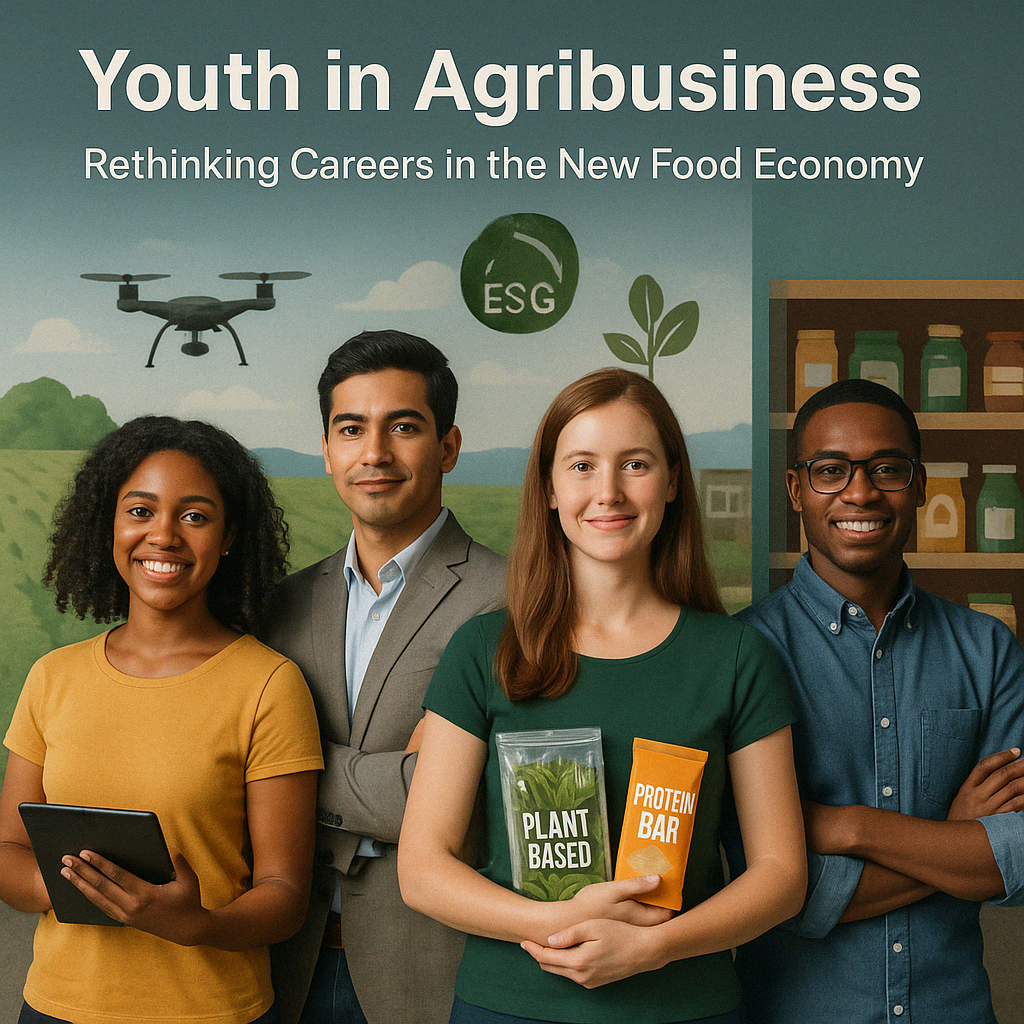
The face of agribusiness is changing — and with it, a new generation of talent is stepping up to lead the transformation. Once seen as a field reserved for farmers or agriculture graduates, the agribusiness sector now sits at the crossroads of sustainability, digital innovation, health, and global trade.
In today’s fast-evolving food economy, there’s room for coders, storytellers, strategists, nutritionists, data scientists, product developers, and sustainability champions. Whether you’re a young graduate, mid-career professional, or aspiring entrepreneur, this is your time to lead the change — not just grow crops, but grow ideas, businesses, and impact.
 The New Food Economy: Why Agribusiness Needs Young Talent
Across the globe, we’re seeing a revolution in how food is produced, processed, and consumed.
Consumer expectations have shifted — today’s buyers demand transparency, clean labels, health benefits, and social responsibility.
Retailers and food brands are moving toward traceable, local, and sustainable sourcing models.
Technology is reshaping the sector — from AI-powered crop monitoring and predictive supply chains to climate-resilient protected farming.
Policy shifts like carbon credits, sustainable finance, and regenerative agriculture incentives are opening up new business opportunities.
This wave of change has created a wide gap in talent. Traditional education models haven’t kept pace with the demands of this “new food economy.” That’s where youth — with digital fluency, fresh perspectives, and entrepreneurial hunger — come in.
 Redefining Careers: From Farming to Food Systems Leadership
Modern agribusiness is far more than cultivation. Careers now span the entire value chain, offering strategic, creative, operational, and tech-driven roles.
Here’s a glimpse of where young professionals are making waves:
1. Digital Agriculture & Precision Advisory
Roles: Digital Agronomist, Agri-Data Analyst, Drone Operator
Tools like remote sensing, IoT, and AI are being used to optimize farm productivity. Youth are leading this tech transition with hands-on data and problem-solving skills.
2. Sustainable Food Product Innovation
Roles: Food Technologist, Nutrition-Focused Product Developer, Clean Label Consultant
Driven by health and sustainability trends, there’s huge demand for functional foods, plant-based products, and minimally processed ingredients.
3. Agri-Entrepreneurship & Local Brands
Roles: D2C Brand Founder, Farmer-Processor Aggregator
Young founders are building “local-to-local” supply chains, especially in Africa and India, combining traditional recipes with tech-savvy distribution.
4. Carbon Markets and Climate Finance
Roles: ESG Analyst, Carbon Project Developer
With the rise of carbon credits and sustainability-linked financing, agribusinesses need experts who understand emissions measurement, impact reporting, and project design.
5. Value Chain Innovation
Roles: Traceability Manager, Logistics Optimizer, Supply Chain Digitalization Lead
Youth are deploying blockchain and cloud platforms to bring traceability, efficiency, and accountability across food value chains.
 Not Just for Agri Graduates: Why Diverse Backgrounds Matter
You don’t need a degree in agriculture to make an impact.
In fact, today’s food system needs skills from:
Tech (AI, IoT, Web3)
Finance (Impact Investing, Agri Finance)
Marketing & Branding
Public Policy & Sustainability
Design Thinking & Product Innovation
Young professionals from diverse academic and cultural backgrounds are redefining how food systems operate — and are helping traditional players evolve.
 Real Stories: Youth Driving Change
Ndidi Nwuneli (Nigeria): A Harvard graduate who founded LEAP Africa and Sahel Consulting, working at the intersection of youth empowerment and agribusiness strategy in West Africa.
Sankalp Sharma (India): A computer science graduate who built a soil health and drone advisory startup, now partnering with FPOs to scale regenerative practices.
Maya Vishwanathan (UK): A product design graduate who developed a traceability-driven D2C brand for South Asian spice blends, leveraging her cultural roots and consumer insights.
These are just a few examples of how youth are blending knowledge, culture, and innovation to build food systems that are local, transparent, and sustainable.
 Starting Your Agribusiness Journey: Key Steps
Here’s how you can explore a meaningful career in agribusiness:
Know your strengths: Are you analytical, operational, creative, or entrepreneurial?
Explore the food value chain: From inputs to retail, there’s a role for everyone.
Build business and system thinking: Understand how markets work, what consumers value, and how to turn an idea into a sustainable business model.
Invest in future-ready learning: Education focused on real-world challenges, not just theory, is your best launchpad.
The Mini MBA Advantage: A Launchpad for the New Food Leaders
The Mini MBA in Food & Agribusiness from Agribusiness Academy is designed exactly for this purpose:
Learn from global cases and cutting-edge innovations
Understand value chains and business models
Gain confidence to lead in roles across sustainability, digital, and supply chains
Tailored for students, professionals, and entrepreneurs — with flexible, case-based learning
If you’re looking to turn curiosity into competence, and competence into impact — this is your moment.
 Key Takeaways
Agribusiness is no longer just about production — it’s about systems thinking, sustainability, and innovation.
Youth have a powerful role to play, especially when equipped with cross-disciplinary skills and business acumen.
A wide range of careers are emerging across digital agriculture, climate finance, product innovation, and value chain transformation.
You don’t need a background in agriculture — just the mindset to learn, build, and lead.
Programs like the Mini MBA offer the guidance, structure, and inspiration needed to thrive in the new food economy.
 References