Agribusiness Management Jobs: Roles, Pay, and What Gets You Hired
Quick answerAgribusiness management jobs are commercial roles along the food chain: sales, grain, credit, operations, and supply chain. Business and management is the largest share of U.S. food and agriculture openings from 2025 to 2030. Pay depends on the seat. Farm and ranch managers had a May 2024 median wage of $87,980.
What you’ll learn
- Which cluster holds the most U.S. food and agriculture openings from 2025 to 2030
- The roles that keep appearing, from technical sales to supply chain and credit
- How to read a farm-manager median beside one company’s posted range
- The four commercial questions behind a hire who can run the business side
What happens on a farm lane before the order is placed?
Picture a farm lane in eastern South Dakota. An agronomy rep walks a nutrient plan before the order is placed. A few states away, a grain origination associate is on the phone with a grower. The local basis is moving while they talk.
The titles differ. The test is the same. Who is the buyer? How does the product move? Which partner covers the gap? Does the deal still work next season?
Agriculture is the production of crops and livestock. Agribusiness is the commercial system around that production. It includes inputs, farms, processing, logistics, finance, and retail. What is agribusiness management? sets out that distinction. This piece stays on the jobs.
Where do the openings sit through 2030?
Purdue University and the U.S. Department of Agriculture project about 104,766 openings a year, from 2025 to 2030. The count is for people with interest and expertise in food, agriculture, renewable natural resources, and the environment.
The study combines Bureau of Labor Statistics projections with job-posting data. It includes associate degrees and some roles that do not ask for a degree. About 90 percent of the openings are expected to prefer at least an associate degree.
The openings fall into four clusters. Business and management is about 41 percent. Science and engineering is about 21 percent. Food and biomaterials production is about 19 percent. Education, communication, and governmental services is about 19 percent.
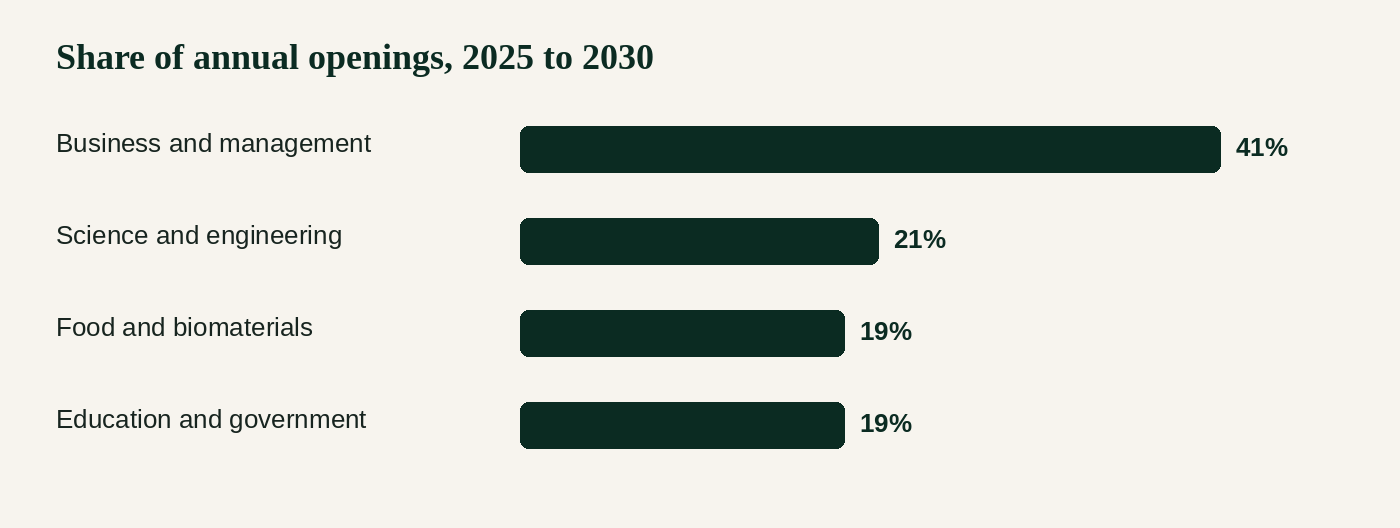
42,855 average annual U.S. openings in business and management tied to food, agriculture, renewable natural resources, and the environment, 2025 to 2030. Purdue University and USDA.
That cluster runs from agricultural inputs and production through food wholesaling and distribution. It also includes management of renewable natural resources. Purdue and USDA expect 16,715 graduates with business and management degrees in this field to enter each year. Those graduates fill about 39 percent of the openings.
Allied fields fill 26.3 percent, or 11,276 seats. The remaining 34.7 percent, or 14,863 seats, are filled by graduates in other fields and by people without a degree.
Across all 104,766 openings, food and agriculture graduates account for 47.8 percent of annual supply, or 50,057 people. Allied disciplines account for 24.6 percent, or 25,802. Employers draw the remaining 27.6 percent, or 28,907, from other graduates. The report includes in that picture roughly 10 percent of jobs filled by candidates without a degree.
The commercial block is the largest share. How a chain is built, and who captures value along it, is in agribusiness value chain training.
Which roles keep showing up?
The business and management cluster names the seats inside that 41 percent. They include lenders, credit and risk analysts, insurance staff, and operations managers. They also include technical sales and key accounts, including offers that combine equipment, inputs, and software.
The same list covers marketing, online sales, and performance marketing. It covers data work for dashboards and forecasting. It covers supply chain, procurement, and project or product management. Consulting on transition planning, financial management, and strategy sits there too.
Demand stays strong for general managers, operations leaders, financial analysts, and risk managers. Technical sales looks favorable where the offer joins equipment, inputs, and digital tools. Project management and supply chain roles are also projected to grow as firms tighten how product moves.
Three postings show how a title becomes a workload and a pay line.
Ingredion lists a senior agribusiness sales representative. The role manages sales for a large plant, including more than $50 million of corn protein feed, with attention to price, freight, and new customers. It asks for at least five years of industry experience and a degree in business, agriculture, or the equivalent. The listed range is $90,400 to $120,533 a year. The company says that range is not a guaranteed salary.
CHS posted an experienced agronomy sales representative in Colton, South Dakota, on 23 September 2026. The work is on the farm: crop protection, nutrients, seed, and related services. A bachelor’s degree in agriculture, business, or a related field is preferred. The listed range is $64,900 to $97,400.
Cargill lists a grain origination sales associate for 2027 in Olathe, Kansas, and Linden, Indiana. The posting is dated 3 August 2026 and lists an expected salary of $66,000, before any geographic adjustment. Seats further from the farm lane are mapped in careers in the new food economy.
What do the pay figures actually measure?
$87,980 median annual wage for farmers, ranchers, and other agricultural managers in May 2024. U.S. Bureau of Labor Statistics.
The Bureau of Labor Statistics outlook covers people who run establishments that produce crops, livestock, and dairy products. The May 2024 median was $87,980 a year, or $42.30 an hour. The lowest 10 percent earned less than $51,700. The highest 10 percent earned more than $156,530.
Typical entry is a high school diploma plus five years or more in a related occupation. The occupation held 836,100 jobs in 2024. Employment is projected to decline 1 percent from 2024 to 2034, a change of 11,100 jobs. The Bureau still projects about 85,500 openings a year, on average, because people move to other work or leave the labor force.
The Purdue and USDA figure is a different count. It is annual openings across four clusters in the wider food and agriculture system. The three company ranges are single advertisements. A grain associate posting can list $66,000. An agronomy territory can list $64,900 to $97,400. A senior feed sales role can list $90,400 to $120,533. A farm or ranch manager at the middle of the Bureau’s distribution earned $87,980 in May 2024.
What do employers already write into the posting?
Purdue and USDA counted how often a skill was mentioned as required or preferred in scraped postings. Experience leads. Programming sits at the bottom of the list they published.
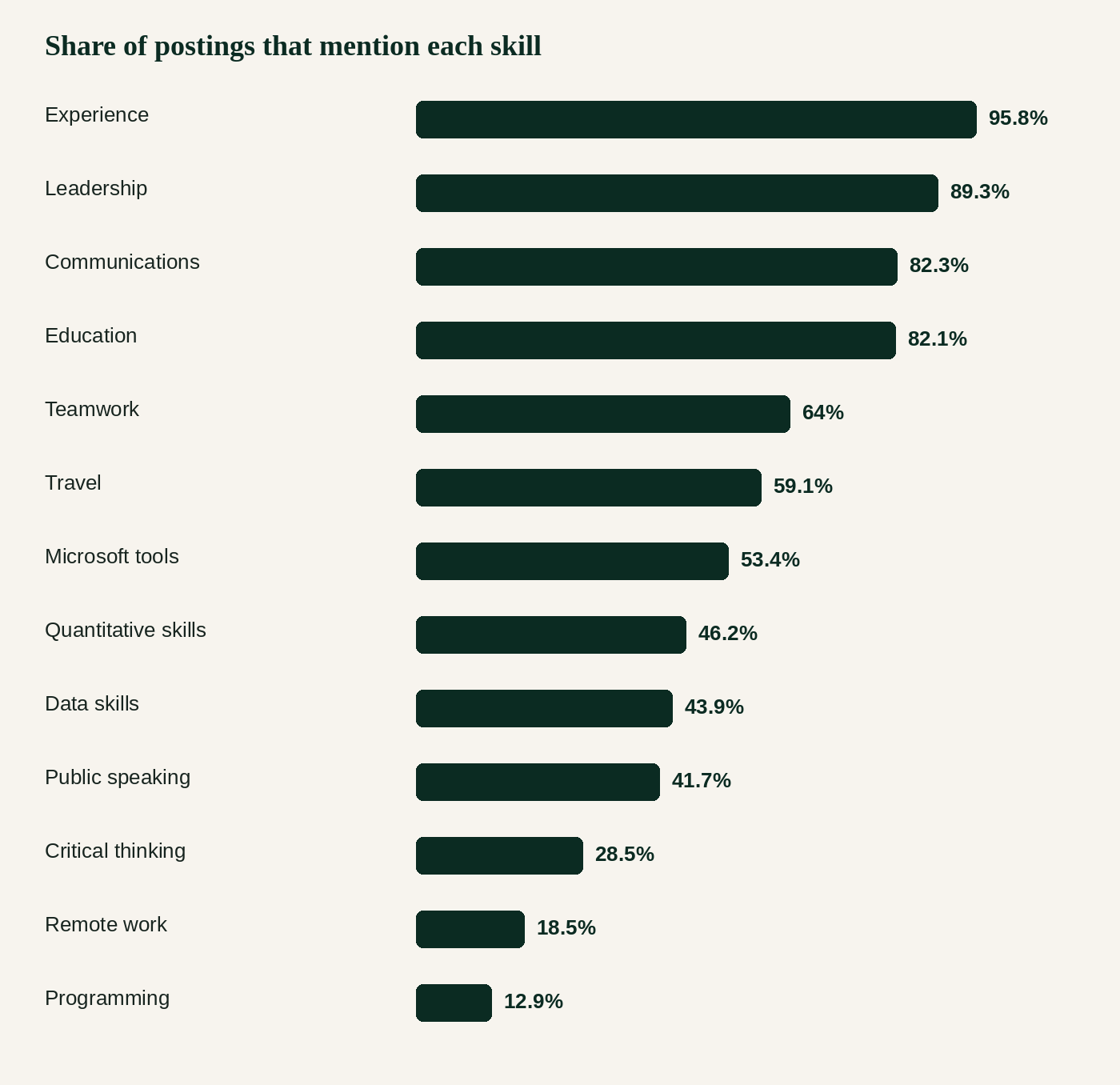
The cluster page says managers are expected to use data in decisions, including in sales. Data appears in 43.9 percent of postings. Microsoft tools appear in 53.4 percent. The skills named most often are still experience, leadership, and communication. Years in the trade are on the posting. The commercial judgment inside those years is what the title leaves open.
What commercial layer gets someone hired?
Who sets the price: the processor, the trader, the retailer, or a public buyer? Which risk is physical, such as yield, quality, or spoilage? Which risk is price, such as a spot sale against a contract?
Basis is the gap between a reference market and the local cash price. It is one of the first numbers a grain desk explains. A delayed truck, a rejected lot, or a quality claim is also a finance event. Inventory and receivables tie up cash.
A business model is the way a company creates value and earns money from it. Four components keep that judgment in order.
Original diagram, Institute of Food and Agribusiness Leadership. The same four components are in the free ebook.
- Value proposition: Who is the customer this week, and why do they choose this offer? A grower locking nutrients, a feed mill buying protein, and a retailer buying a programme are three buyers. The hire who can name the buyer can name why the bid won.
- Distribution strategy: An on-farm visit, a book of grower calls, a terminal, and an online reorder are different routes. A route that fitted last year’s freight and basis can fail when either one moves.
- Complementary chain partnerships: Freight, storage, grading, credit, and input supply are often another firm’s job. The useful hire knows which partner covers which gap.
- Sustainability: The model has to survive the next season, the next buyer, or the next rule. An offer that wins this month and then breaks the grade, the soil, or the contract is a short piece of business.
You can see these same four components on real companies in the free ebook Food and Agriculture Business Models. It draws on 15+ years of research, 300+ business models, and 30+ countries. It is free to start, with no signup.
People who already know a crop, a plant, or a territory can take this layer as a credential. The Foundation Certificate in Agribusiness Value Chains is about 45 hours, AI-coached, and priced at $499. It is co-issued with Avila University. It teaches these four components.
Final takeaway
- Start with the largest block: business and management is about 42,855 U.S. food and agriculture openings a year through 2030.
- Read each pay line as one seat. The Bureau’s May 2024 farm-manager median is $87,980. A single posting can list a very different range.
- Expect postings to ask for experience, leadership, and communication before they ask for programming.
- In the interview, name the buyer, the route, the partner, and whether the deal still works next season.
- Use the same four components on a live account before you treat a title as the job.
Frequently asked questions
What is an agribusiness management job?
It is a commercial role in the food and agriculture chain. The work can be operations, credit and risk, technical sales, marketing, supply chain, procurement, or advisory work. Purdue and USDA place business and management at about 41 percent of annual openings in that wider field from 2025 to 2030. That is about 42,855 openings a year.
How do these jobs differ from farm manager roles?
Farm managers run crop, livestock, and dairy establishments. The Bureau of Labor Statistics counts them as farmers, ranchers, and other agricultural managers. The Purdue and USDA business cluster is wider. It includes inputs, processing, wholesaling, distribution, and renewable resource management, along with those production seats.
What do agribusiness management jobs pay?
The Bureau reports a May 2024 median of $87,980 for farmers, ranchers, and other agricultural managers. In single postings, Ingredion listed $90,400 to $120,533 for a senior sales role. CHS listed $64,900 to $97,400 for experienced agronomy sales in Colton, South Dakota. Cargill listed an expected salary of $66,000 for a grain origination associate.
Which skills do employers list most often?
In the Purdue and USDA scrape, experience appeared in 95.8 percent of postings. Leadership appeared in 89.3 percent. Communications appeared in 82.3 percent. Data skills appeared in 43.9 percent. Programming skills appeared in 12.9 percent. The posting names the years. The work still asks whether you can read a deal.
Why does a degree not fill every opening?
About 90 percent of the wider openings prefer at least an associate degree. Inside business and management, food and agriculture graduates are expected to fill about 39 percent of openings. Allied fields fill 26.3 percent. Other graduates, and people without a degree, fill the remaining 34.7 percent.
Free to start. No signup.
Read the ebook
15+ years, 300+ business models, 30+ countries. The same four components, on real agrifood companies.