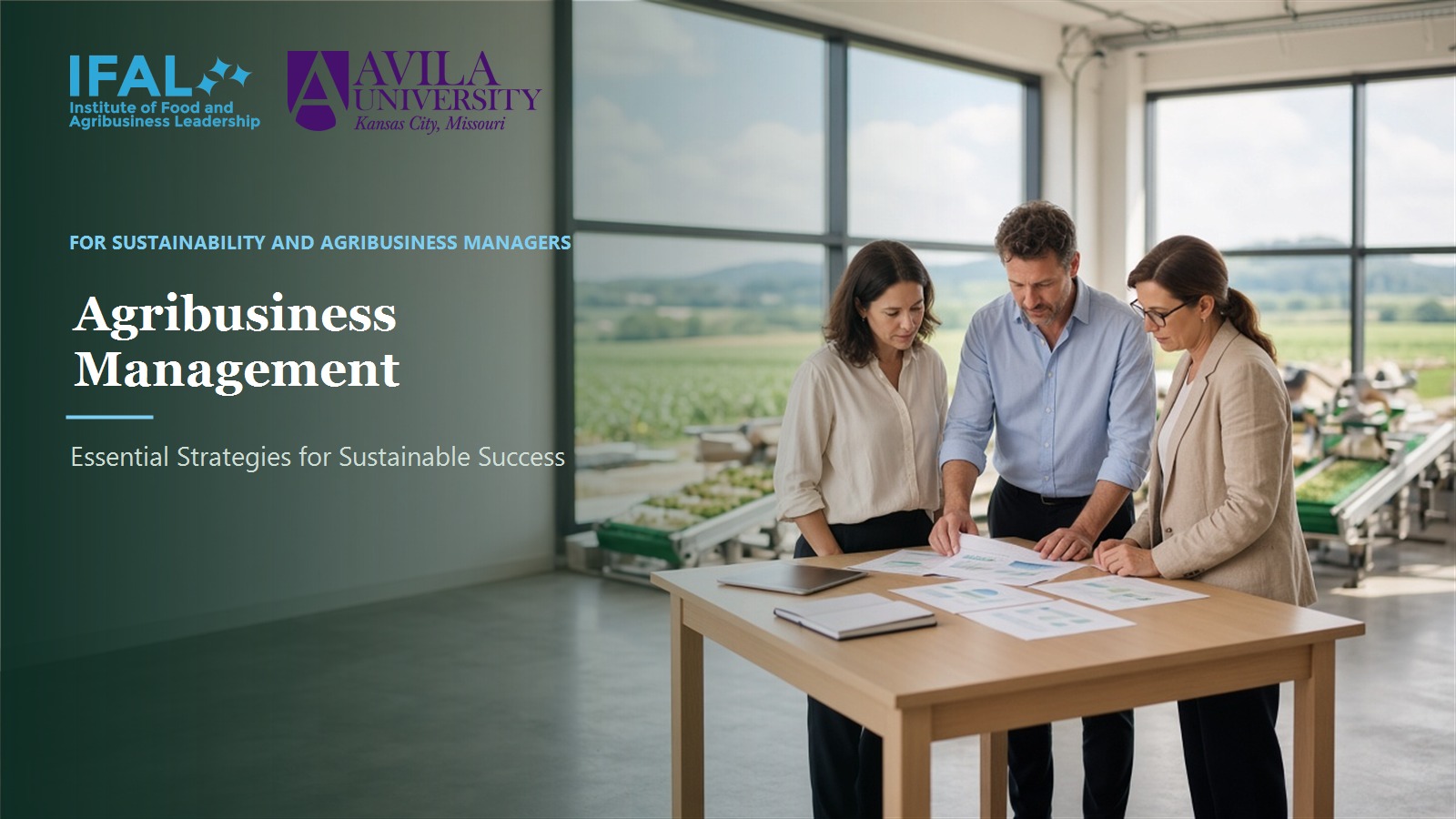
Agribusiness Management: Essential Strategies for Sustainable Success
A sustainability manager walks into the quarterly review with a solid report: emissions, water, a supplier questionnaire, a target for next year. Procurement is there to talk about cost. Sales wants the specification that wins the buyer. Operations wants the line to keep running. Everyone is competent, and the meeting still ends without a decision, because each person is managing a different piece of the business and nobody is managing the model that holds the pieces together.
That is the job of agribusiness management. It is not a longer list of farm practices. It is how a food and agriculture business creates, delivers, and keeps value, including the sustainability work that only lasts when it is part of the model.
What you will learn
- How agribusiness management differs from agriculture
- The four strategies that make a food business commercially durable
- Where sustainability sits inside that framework, rather than beside it
- How a manager can test the four strategies on one live account
Agriculture grows the product. Agribusiness management makes it a business
Agriculture is production: crops, livestock, soil, water, and inputs. Agribusiness is production plus the commercial system around it, from input supply and processing through logistics, finance, and retail. Agribusiness management is the practice of making that system work. Our plain-English guide to agribusiness management sets the distinction out in full, and What is Agribusiness? is the shorter starting point.
A manager who only optimises the farm, the plant, or the report will keep winning arguments inside one function and losing them in the room where price, channel, and partnerships are decided. Sustainable success is a management outcome. It shows up as margin that survives a bad season, a buyer who stays, and a sustainability claim the operating model can actually carry.
Four strategies, one framework
The current framework used across IFAL’s work, and in the Foundation Certificate in Agribusiness Value Chains, reduces agribusiness management to four strategies. They are the same four a sustainability manager, a commercial lead, and an operations lead can answer about the same customer.
- Value proposition. Who is the customer, what problem do they pay you to solve, and why do they choose you over the alternative on the shelf or the bid list?
- Distribution strategy. Is the route to market built around that value, or is it the channel that was easiest to open years ago?
- Complementary chain partnerships. Which capabilities do you deliberately borrow from partners, and which gaps are you filling by accident?
- Sustainability components. Is durability designed into the model, or added later as a compliance line?
None of these replaces technical skill. They sit above it, which is why a well-trained agronomist, a sharp buyer, and a careful sustainability lead can still describe one account three different ways. The same argument is made for employers in a free agribusiness workforce training resource, and for cross-functional teams in why value chain thinking is the new competitive advantage.
What this looks like for a sustainability manager
Sustainability work fails in agribusiness when it is managed as a report. It holds when it changes one of the four strategies.
- A recycled pack that the buyer did not ask for is not a value proposition. A freshness or traceability promise the buyer will switch suppliers to keep is.
- A shorter, specialist route to market can cut waste and raise margin at the same time. A broad, habitual route often does neither.
- A partnership is complementary when the other firm supplies a capability you should not build, such as cold chain, certification, or last-mile delivery. A logo on a slide is not a partnership.
- A sustainability target bolted on after the price, the pack, and the channel are fixed will be the first thing cut. A target designed into those choices survives the next budget round.
Honing Tomaten spent years as an anonymous tomato supplier inside an auction chain, with no pricing power and no relationship with the eater. The turnaround was a sharper value proposition, a direct relationship with specialist grocers, and a use for rejected fruit in its own ketchup line. The sustainability move worked because the commercial model had already been rebuilt. That case, and two others from different parts of the chain, are worked through in Food and Agriculture Business Models.
Run the four strategies on one live account
Managers do not need another principles poster. They need one hour on a real account.
- Pick one customer, supplier, or product line with a decision due this quarter.
- Ask commercial, operations, and sustainability to write the four answers before the meeting, each from their own seat.
- Read the value propositions side by side first. Disagreement there is the finding.
- Then test distribution, partnerships, and sustainability, and keep every claim tied to where margin is made or lost.
- Leave with one decision, one owner, and a date to review it.
The skills underneath that conversation are the ones in the top skills agribusiness professionals need, and the money questions sit in Path to Profitability in Agribusiness. The framework is what stops those skills staying in separate departments.
Where structured study fits
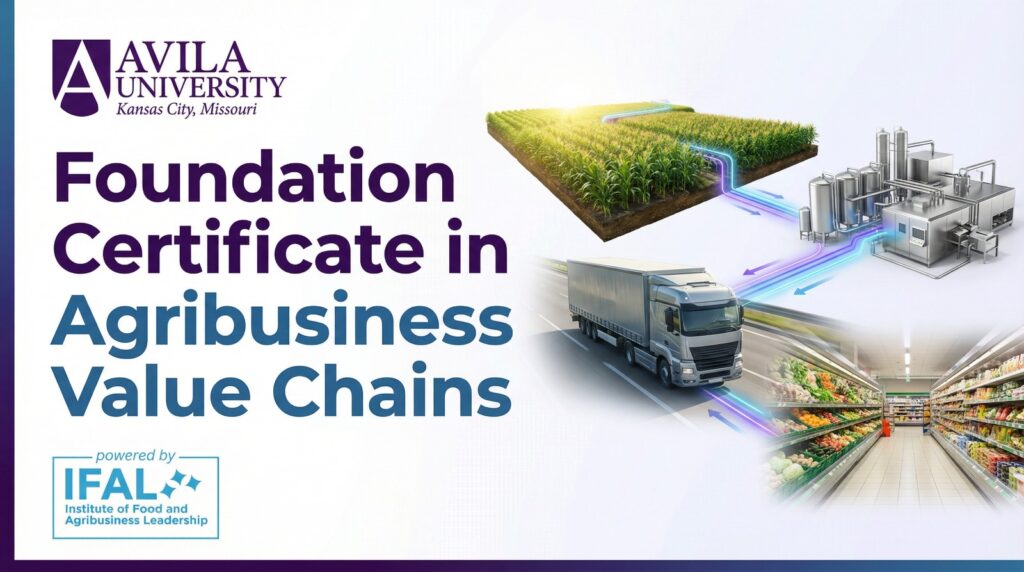
The working session shows the gap. People who want the full commercial system, from production decisions through distribution, business model design, and value chain finance, can go on to IFAL’s Foundation Certificate in Agribusiness Value Chains: about 45 hours, self-paced, AI-coached, and co-credentialed with Avila University. For a sustainability or commercial manager, the useful first step is still the shared reading, not a new course catalogue.
Frequently asked questions
What is agribusiness management in practice?
It is the management of the commercial food and agriculture system: who the offer is for, how it reaches them, which partners make that possible, and whether the model can last. Production skill is an input to that work, not a substitute for it.
How is this different from a sustainability programme?
A sustainability programme often measures impact. Agribusiness management asks whether that impact is built into the value proposition, the route to market, and the partnerships. If it is not, the target stays a report.
Do these four strategies replace financial management?
No. Cash flow, margin, and risk still have to be managed. The four strategies tell you which commercial choices those numbers are describing.
Who should use this, beyond sustainability managers?
Commercial managers, procurement leads, founders, and learning leads who need one language across functions. The same four questions work in a management meeting and in a team development session.
Can a team start without a new training platform?
Yes. One live account, the four questions, and the free book below are enough to run the first session.
Final takeaway
Sustainable success in agribusiness is not a yield target with a responsibility chapter attached. It is a business model a manager can explain: a clear value proposition, a route to market chosen on purpose, partnerships that fill real gaps, and sustainability designed into those choices.
Read Food and Agriculture Business Models before the next account review. It is free to start, with no signup, and it is built from 15+ years of research across 300+ business models in more than 30 countries. It uses these four strategies on real companies, including Honing Tomaten, What Chefs Want!, which grew from one produce van in Louisville to more than 16,000 restaurants by refusing the broadliner model, and ProducePay, which finances fresh-produce growers that ordinary farm lending left out. Take one case, then put the four questions on the account your team cannot agree about.